AND THE PLANET… DISAPPEARS! THE MYSTERY OF TOI-2535 b
A giant about a thousand light-years away has stopped crossing its star from our viewpoint. A neighbour’s gravity is changing its orbit. Watch the animation to see how.
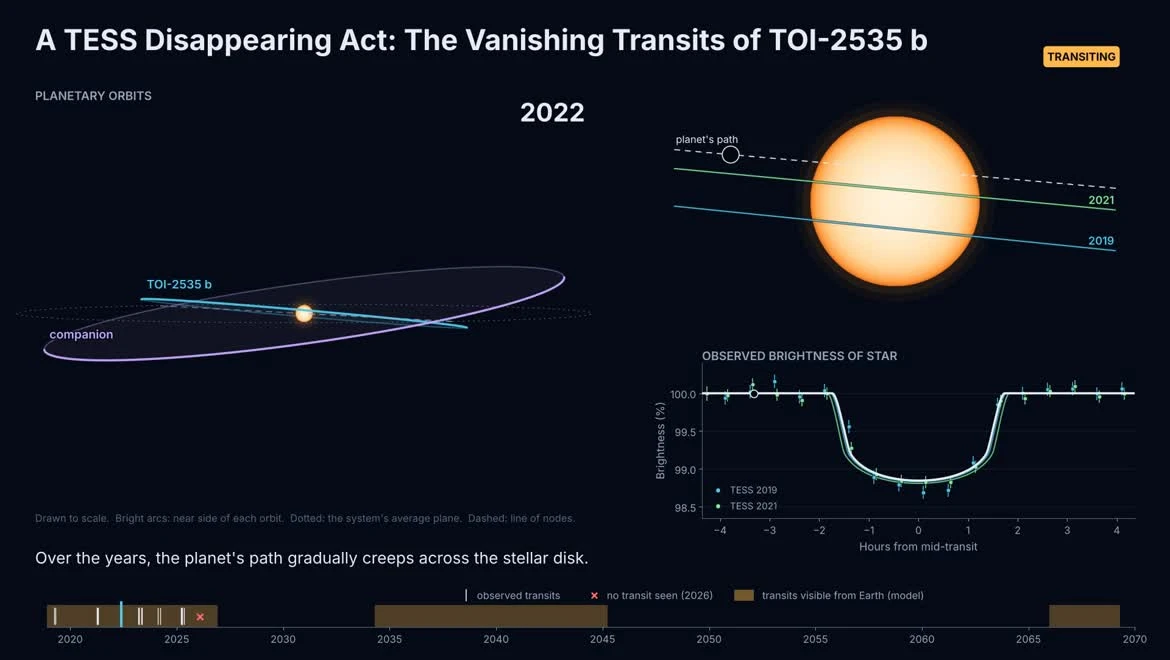
You wait for it where it has appeared so many times before. You measure its star’s light and look for the little dip that marks the appointment. Nothing. TOI-2535 b, a giant planet about a thousand light-years away, has stopped casting its shadow across its star in our direction. Following that absence as it developed is what makes this discovery so intriguing.
The planet is still there, still orbiting. What changes is the orientation of its path: a neighbour’s gravity gradually tilts the orbit until the alignment that let us detect those crossings is lost. It is a story of celestial geometry, with a protagonist that arrives early, turns up late and eventually misses the appointment altogether.
The giant with a very short year
TOI-2535 b belongs to the hot Jupiters, gas giants orbiting extremely close to their stars. It completes a circuit in about 8.25 Earth days. For a sense of the pace, Mercury takes about 88 days to orbit our Sun. This world’s calendar moves quickly: a little more than a week and another year begins.
The word hot describes an extreme environment linked to that proximity. Imagining another Earth with fields, seas and a lovely beach would take you in the wrong direction. The wonder here lies in the system’s movement and in our ability to notice it changing by comparing measurements collected over several years.
Finding a planet without taking its portrait
Think of a lamp with a little ball passing in front. From the right position, you briefly receive less light. The transit method follows that principle: when a planet crosses the apparent disc of its star, the measured brightness falls slightly. Record many crossings and you can identify a repeating pattern and examine its details.
The observation mainly concerns the star’s light rather than a close-up picture of the planet. The TESS space telescope searches for precisely these small signals. The depth of the dip, its duration and the interval between events carry different information. A light curve that initially looks like a line with a few dents can tell the story of an entire world.
Early arrivals, late arrivals and a shorter shadow
TESS observations between April 2019 and March 2026 revealed something unusual. TOI-2535 b’s appointments did not follow a perfectly regular timetable: some transits arrived early or late, with differences of up to six hours. Meanwhile, the crossings grew shorter and the dips in brightness became shallower.
Imagine drawing a pencil line across a round plate. A line through the centre crosses a long stretch; a line close to the rim crosses a shorter one. Move it a little farther and it misses the plate entirely. That simple picture helps explain how a change in alignment can shorten a transit until it disappears.
The neighbour making the orbits wobble
The system’s model points to a second planet whose orbit is tilted relative to that of the observed giant. The two bodies interact through gravity, altering the orientation of their respective orbits. A spinning top offers a useful picture: it keeps turning while the direction of its axis can also change.
The neighbour is inferred from its effects on the system’s motion. Its precise properties remain under investigation; we do not have every orbit photographed and mapped like streets in a town. The strength of the discovery is the measured transformation itself, rapid enough to become apparent during the period of observations.
Will the crossings return?
TOI-2535 b is predicted to transit its star again in roughly thirty to fifty years. That is a forecast based on the orbital model, rather than a guaranteed appointment to circle on a calendar. Its companion could enter a favourable alignment sooner. Continued observations will help test these reconstructions.
In the meantime, the system remains valuable. Planets affect their neighbours’ motion even when they do not provide a visible transit. Astronomers can compare different signals, including changes in the star’s velocity along our line of sight. Each technique addresses part of the problem, and bringing them together makes the explanation stronger.
An eclipse closer to home helps
Why do we not see a solar eclipse every month, at every new Moon? The Moon’s orbit is tilted relative to the plane of Earth’s orbit, so it often passes a little above or below the required alignment. The visible effect depends on the observer’s position and the arrangement of the bodies.
The sizes, distances and causes of the changing orbit are different for TOI-2535 b, but that geometric requirement becomes familiar. Orbiting a star is not enough to cross its face from our perspective. A planet can therefore escape the transit method while remaining very much present in its system.
Watch the orbit first, then the light
Samuel Yee’s scientific animation lets you follow the orbits alongside the changing light signal. Begin with the planet’s path and watch its position relative to the viewing direction. Then look at the transit signal. The shift from a favourable geometry to an unfavourable one becomes much easier to grasp.
You can explore the idea on a table with a little ball and a stationary lamp, keeping bright light away from your eyes. Shift the ball’s path slightly relative to your viewpoint: the crossing disappears while the object remains. It is a brief activity for sharing a faraway discovery with children and letting them find the right position themselves.
The sky has a talent for reminding us how much our viewpoint matters. Continue the journey by discovering how far Voyager 1 has travelled or planning a night with December’s Geminids. Next time a shadow fails to appear, you will have another question worth asking.
Samuel Yee / UCLA ↗ · Open the original video ↗
SOURCES AND FURTHER READING
Did this story touch your heart?
Psst… you’ll like this too!
Who’s there beyond Pluto? A newly discovered world makes us look up
Read the story ↗Share this story