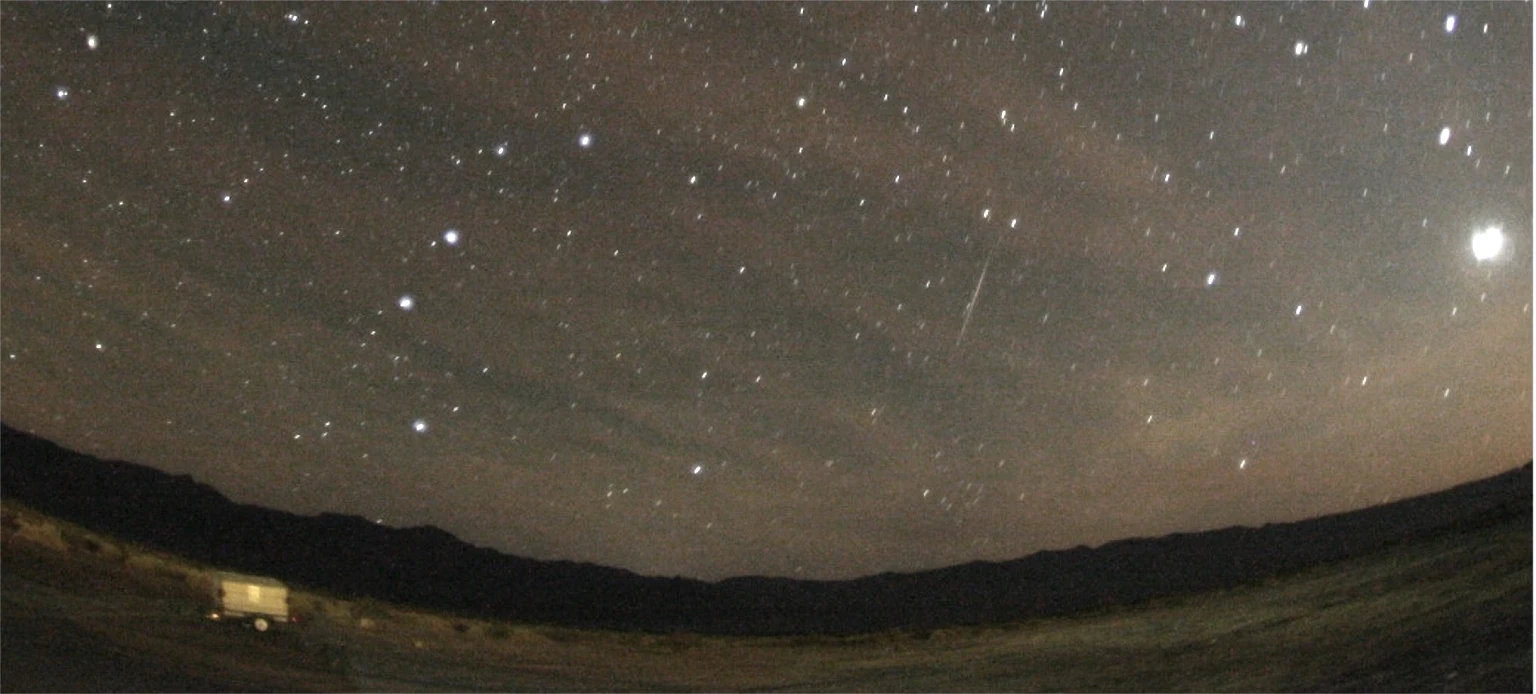
The shooting stars are back in December. Save a night
The best night to see the Geminids from Italy is **Sunday 13 to Monday 14 December 2026**. You can start **from 22:00 CET**. Pick a dark place with a broad view, give your eyes about twenty minutes to adjust and watch with the naked eye. The Moon will be a thin waxing crescent.
Pick a main night and a back-up
If you only have an hour, choose Sunday evening, 13 December, and make some time after 22:00. That is the peak night and the timing also works if you have to get up early on Monday. You can begin without waiting for midnight. On the peak night the Moon is about 15 percent illuminated. A thin crescent like that means less moonlight, provided local lights and clouds leave you enough clear sky.
If the forecast for the 13th is cloudy, keep the evening of the 12th or 14th in reserve. The shower is active between 4 and 17 December. One of the adjacent nights can save the outing when the weather changes, though you may see fewer meteors than at the peak. Half an hour of clear skies on your back-up night is a better use of your time than an hour staring at cloud on the peak night. Check the weather the day before and again a few hours before you leave.
Which way should you look?
The Geminids take their name from Gemini. If you trace their streaks backwards, their paths appear to meet in the same area of the sky, known as the radiant. A sky map can help you find that region. Then put the phone away and take in a wider view. Meteors can cross many parts of the sky. A big, dark patch that lets you watch without twisting your neck is a good choice.
Think of the difference between sitting in front of a picture window and looking through a keyhole. With a wide view, you are more likely to notice a flash at the edge of your vision. A telescope or binoculars give you a narrower field and work better for objects you can keep in view for longer. The most useful piece of equipment for this outing is a reclining chair or somewhere comfortable to lean back. Let the sky do the rest.
Choose a spot while it is still light
A terrace can work if buildings and streetlights leave you a good stretch of sky. If your eyes are drawn to a bright light in the courtyard, find a spot that blocks it. If you can travel out of town, look for a place you have permission to enter, with parking nearby and a path you would recognise in the dark. Visit first in daylight if you can. A good spot lets you stay put comfortably without having to walk beside a road looking for a gap between the trees.
If you are heading out with friends, agree where to meet and when to go home. Bring an extra layer compared with what you would wear on a walk. You will feel the cold more while sitting still. A warm drink and something insulating between you and the chair can make the wait more comfortable. If you are bringing a child, pick a spot that is easy to leave. An outing can still be a success if everyone decides that it is time to go home early.
Give your eyes time to adjust
Once you have settled, turn off the screen. Give yourself at least twenty minutes, or half an hour if you can. You might see very few stars at first and wonder why you came out. A little later, details you could barely make out begin to stand out. If you need to use your phone, set the brightness as low as possible. Turn away from lights shining directly at you and keep clear of headlights from passing cars.
Meteors arrive at their own pace. Sometimes two come close together, followed by several minutes when nothing seems to happen. If you are watching with someone, you can each look at a different part of the sky and tell each other about the streaks you actually see. As a small record of the evening, write down roughly when a meteor passed, which way it went and what colour you remember. One observation is enough to compare with what someone else saw. Under city skies it is easier to enjoy the night if you start without a target number in mind.
Where the lights come from
A shooting star is a meteor. The streak appears when a small fragment enters Earth’s atmosphere at high speed. In December, Earth crosses a region containing the debris that produces the Geminids. The shower is associated with the asteroid 3200 Phaethon. That is one of its curious features: many meteor showers are linked to comets. The name to remember here belongs to a rocky object that travels very close to the Sun.
Some Geminids look bright and colourful. If you are trying to tell a meteor from an aircraft, pay attention to how long it lasts. A meteor appears and vanishes quickly. An aeroplane moves steadily across the sky and may have lights that flash at regular intervals. A streak caught out of the corner of your eye is still worth talking about, even if you just want to compare notes with the friend beside you.
Source: NASA JPL ↗
The version to save
Put ‘13 December, 22:00 CET’ in your diary. Add a place with a wide view and keep a second evening free if you can. Bring a warm layer, let your eyes get used to the dark and watch with the naked eye. If the weather closes in, you already have an alternative. If the sky is clear, stay for five more minutes when everyone says it is time to go. That can be the moment you most want to look up.
If you are planning the evening with someone who has never watched a shower before, let them choose where to sit. A comfortable patch of sky you can both see is more useful than spending the first ten minutes pointing out a constellation on a very bright phone.
If you are choosing between two places, put the one with the wider, darker view first. Take a short spell to watch quietly. Afterwards, share the first thing you noticed, even if it was a group of stars emerging before any meteor appeared.
SOURCES AND FURTHER READING
Did this story touch your heart?
Psst… you’ll like this too!
The Hunter’s Moon: why it has that name and what to watch in the sky
Read the story ↗Share this story