The Hunter’s Moon: why it has that name and what to watch in the sky
The full moon on 26 October invites us to look up. Its name comes from tradition, its light from the Sun, and the wonder can come from us. Here is how to give ourselves a small appointment with the sky.
For one evening, let us try a different direction. The phone can wait a few minutes; the sky is already above us. October’s full moon reminds us of something simple: there are spectacles for which we need neither a booking, a perfect appearance nor a clever caption. We only need to go out, find a piece of horizon and look.
It is often called the Hunter’s Moon. The name sounds like a story’s title, and in a way it is: a trace of how people have watched the seasons change. Knowing the explanation takes no poetry away from the evening. It gives us another detail to share with someone beside us.
26 October, at 05:12 in Italy
The US Naval Observatory’s ephemerides give the full moon on 26 October 2026 at 04:12 UTC, equivalent to 05:12 in Italy after the return to standard time. This is the astronomical instant of the full phase, not the time the Moon rises in every city. Moonrise and its position in the sky require information for your own location.
If you were asleep then, the evening is not lost. The disc changes gradually and can appear almost fully illuminated in the hours around the exact full phase. For a little observing session, what matters most is a sky reasonably free of clouds and a clear horizon. Precise ephemerides help us understand the phenomenon; they do not turn wonder into an appointment we must keep to the second.
Why “Hunter’s”?
Hunter’s Moon belongs to full-moon naming traditions widespread in the English-speaking world and North America. It relates to the time of preparation for winter, including hunting and preserving food. It describes neither a new kind of Moon nor a transformation of its surface. It is a cultural name, connecting observation of the sky with life on Earth.
Traditional names do not make up a single universal calendar: they vary among places and communities. That is worth remembering when lists seem to assign each month a meaning for everyone. We can appreciate a tradition without flattening differences. A name can spark curiosity without becoming a prediction about our destiny.
The light comes from the Sun
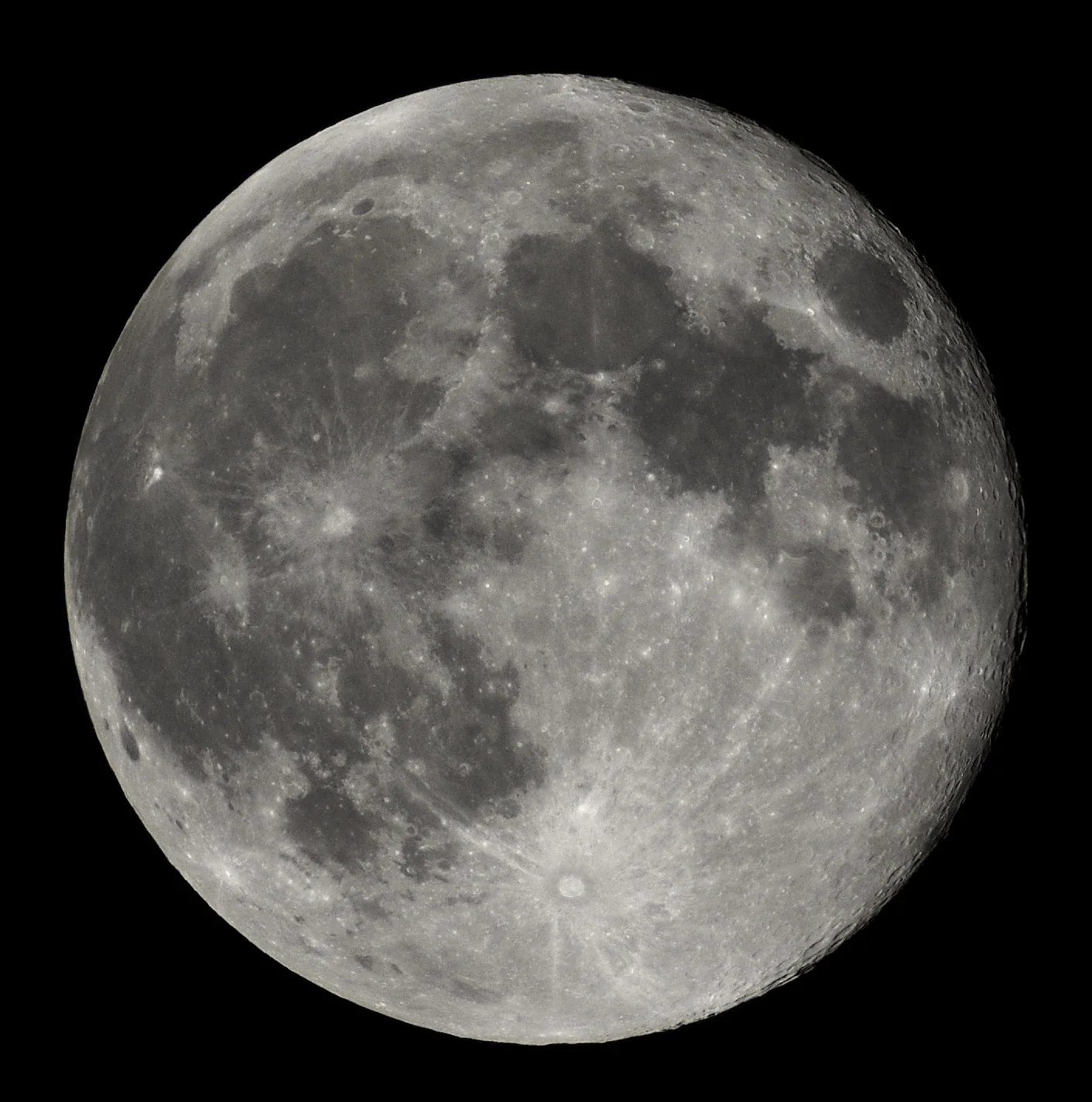
NASA explains that we see phases because the portion of the Moon’s sunlit half visible from Earth changes. At full moon, the side facing us appears almost entirely illuminated. The Moon reflects sunlight; it does not light itself from within. Ordinary phases are not caused by Earth’s shadow, which comes into play during lunar eclipses.
The NASA animation included here helps show the geometry. It is an explanatory illustration, not footage from this night. The photograph also accompanies the astronomical subject; it is not presented as a picture taken during the full moon of 26 October 2026. Distinguishing documentation, illustrative material and current observations makes storytelling about the sky better too.
That enormous Moon on the horizon
When the disc is low, near buildings, trees or mountains, it can seem much larger. NASA describes the Moon illusion as a perceptual phenomenon: the impression does not match the enormous physical increase we seem to see. To explore the difference, compare photographs taken at the same focal length without changing magnification. The comparison only makes sense if the pictures are not cropped differently.
No equipment purchase is needed to observe. A nearby, accessible place with some open sky can be enough. Check local weather, take something warm and choose somewhere comfortable. If taking photographs, a steady support for the phone and a few exposure experiments already make a small workshop. The first shot does not have to be the right one.
An appointment can be a phone call too
Not everyone can go out whenever they wish. Some are working, caring for a relative or low on energy. You can look for the Moon through a window or message a friend: “Have you seen it too?” A tiny way to remember one another. The sky does not erase distance, but it can offer something to watch together from different places.
If you are with a child, leave room for questions. Why does it follow us? How does it change? Does anyone live there? You need not have every answer immediately. You can look together, beginning with NASA’s explanations. Shared curiosity does not require all-knowing adults, just people willing to pause and learn.
Sister Moon, five minutes of gratitude
For those who believe, looking can become a short prayer: gratitude for beauty, a name entrusted to God, a silence in which to breathe. The Franciscan reference to Sister Moon invites familiarity with creation, recognising a gift we have not made ourselves rather than searching for secret messages.
If there are clouds tonight, you will not have failed an appointment. Keep your curiosity for another night. The most precious part of this little exercise remains available: looking up, letting go for a moment of what presses on us and noticing the world. The Moon follows its course. Occasionally, we can give ourselves time to watch.
Source: NASA Science ↗ · Open the original video ↗