Zoozve, Venus’s quasi-moon whose name began with a mistake
A poster in a child’s bedroom, a misread designation and a dad determined to understand it. This asteroid’s story sounds invented, but it led to an official astronomical name.
Say it aloud: Zoozve. It hardly sounds like a catalogue designation. Before becoming an asteroid’s name, it was a misunderstanding: the kind we might laugh about, correct and forget. Here, someone decided to ask another question.
That person was Radiolab host Latif Nasser. On his son’s Solar System poster, he noticed an unfamiliar name beside an object associated with Venus. His curiosity began an investigation involving astronomers, an illustrator and a handwritten designation that could look like something else.
Before the funny name, a real asteroid
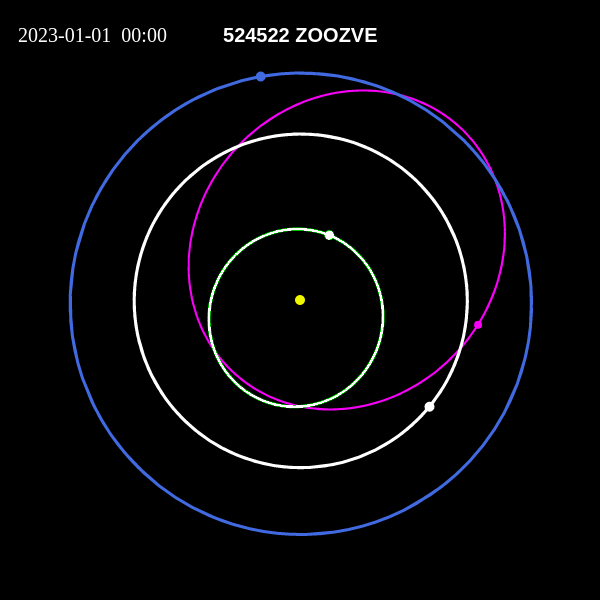
The object exists: asteroid 524522 Zoozve, originally designated 2002 VE68. Brian Skiff, an astronomer at Lowell Observatory, discovered it in November 2002.
Its unusual movement in relation to Venus earns it the description quasi-satellite. That word distinguishes situations that can appear similar from one perspective but are physically different.
Why call it a quasi-moon?
Our Moon orbits Earth. Zoozve follows an orbit around the Sun in a dynamical relationship with Venus’s orbit. In a frame of reference moving with Venus, it appears to loop around the planet. That apparent behaviour explains the term quasi-satellite.
Imagine two people travelling along different routes: changing where you observe them from can change how one seems to move relative to the other. This is not an orbital model, but it helps explain why perspective matters. An astronomical animation makes the distinction visible.
Simply saying ‘Venus has a moon’ would therefore be misleading. The word ‘quasi’ contains the interesting information: something resembles a satellite while working differently.
The poster and the handwriting
Illustrator Alex Foster misread the beginning of the provisional designation 2002 VE while transferring his notes onto the poster. Numbers became letters, producing Zoozve.
Nasser traced the misunderstanding and involved Skiff in an attempt to make the name official. The proposal succeeded: Zoozve became an official name in 2024. A lettering mistake entered astronomical nomenclature, without changing the object’s orbit or nature.
Perhaps the loveliest part is the curiosity that sustained the story. Something did not fit, someone sought an explanation, and the answer opened a door onto a little-known phenomenon.
A small question can open the sky
You do not need to begin with a grand mystery. ‘What is that name on the poster?’ was enough to reach orbits, observations and scientific procedures. It is a reminder when science seems like a place you can enter only after learning the right words.
We can start with curiosity, find people who study the subject and accept an explanation that corrects our first impression. Zoozve remains fascinating when we discover it is not a moon like ours. Understanding does not spoil wonder; it gives it more detail.
A mistake need not be the final word
In this story, a mistake sparked curiosity. Someone followed it, asked questions and found a name that now makes us smile when we look towards Venus. A lovely meeting of distraction, research and imagination.
Perhaps that attitude is what we can keep. When something does not fit, try to understand it before feeling ashamed. An honest question does not make us less capable. Sometimes it lets us learn something that would otherwise have remained on a wall.
For believers, learning about creation can also become gratitude. A universe still to explore, people who spend years studying it and a funny name that makes us want to know more. Even a small question can make us look up.
Had you heard of Zoozve? What name would you give a small world waiting to be discovered?