Who’s there beyond Pluto? A newly discovered world makes us look up
Named 2026 ED138, it was identified in Rubin Observatory data beyond Neptune. It could be a dwarf planet: here is what we know and what remains to be established.
Our cosmic neighbourhood still has surprises. While we work out what to pack for a weekend away, astronomers have identified a distant world hidden in a crowded field of stars. Its provisional name sounds like a password: 2026 ED138. The discovery is much more exciting than the name.
NSF–DOE Vera C. Rubin Observatory has announced its first dwarf planet candidate. The International Astronomical Union’s Minor Planet Center announced the observations on 27 October 2026. It opens a wonderful question: how much remains to be discovered within our own Solar System?
That word “candidate” matters
2026 ED138 is a trans-Neptunian object, a body orbiting the Sun beyond Neptune. Researchers think it could be large enough to qualify as a dwarf planet. Further observations are needed to confirm its nature.
The object has been detected; its final classification remains to be established. This does not mean a new member has joined the eight planets we learnt about at school. Scientists are working out how best to describe another body in our Solar System.
That distinction makes the discovery more interesting. We are seeing research develop, including the questions scientists still need to answer.
How far away? Time for a different scale
The researchers place ED138 at a current distance of about 46 astronomical units from the Sun. One astronomical unit is the average Earth–Sun distance. Pluto, for comparison, has an average distance of approximately 40 astronomical units.
The comparison needs care: ED138’s figure describes its current position, while Pluto’s is an average. These bodies move around their orbits. “Beyond Pluto” gives a sense of the remote region involved, rather than describing a fixed queue of worlds.
It can be difficult to imagine such distances. School diagrams suddenly feel too small. Astronomy invites us to slow down and change our sense of scale, even when we are reading on a phone.
How large is this world?
The estimated diameter is between 600 and 1,500 kilometres. That broad range reflects uncertainty about how much sunlight the surface reflects, a property called albedo.
Imagine a brighter surface and a darker one. The light we detect depends on reflectivity as well as size. Scientists therefore need more information, particularly infrared observations, to narrow the estimate and understand the object better.
Words such as “estimated” and “could” belong in this story. They let us follow a discovery without confusing an initial result with a complete set of answers.
Older images helped tell a new story
Matthew Holman of the Center for Astrophysics | Harvard & Smithsonian identified the object while analysing Rubin data. Mario Jurić of the University of Washington helped find additional observations, connecting detections made at different times.
Archival Dark Energy Camera images also helped reconstruct the object’s path, with observations extending back to 2016. Something can already be present in an image before anyone realises what they are looking at.
A discovery can therefore involve retracing earlier steps. Old observations gain new meaning once researchers know where to look. Instruments matter, alongside the patient checking needed to establish that distant points of light belong to the same object.
Why was it difficult to find?
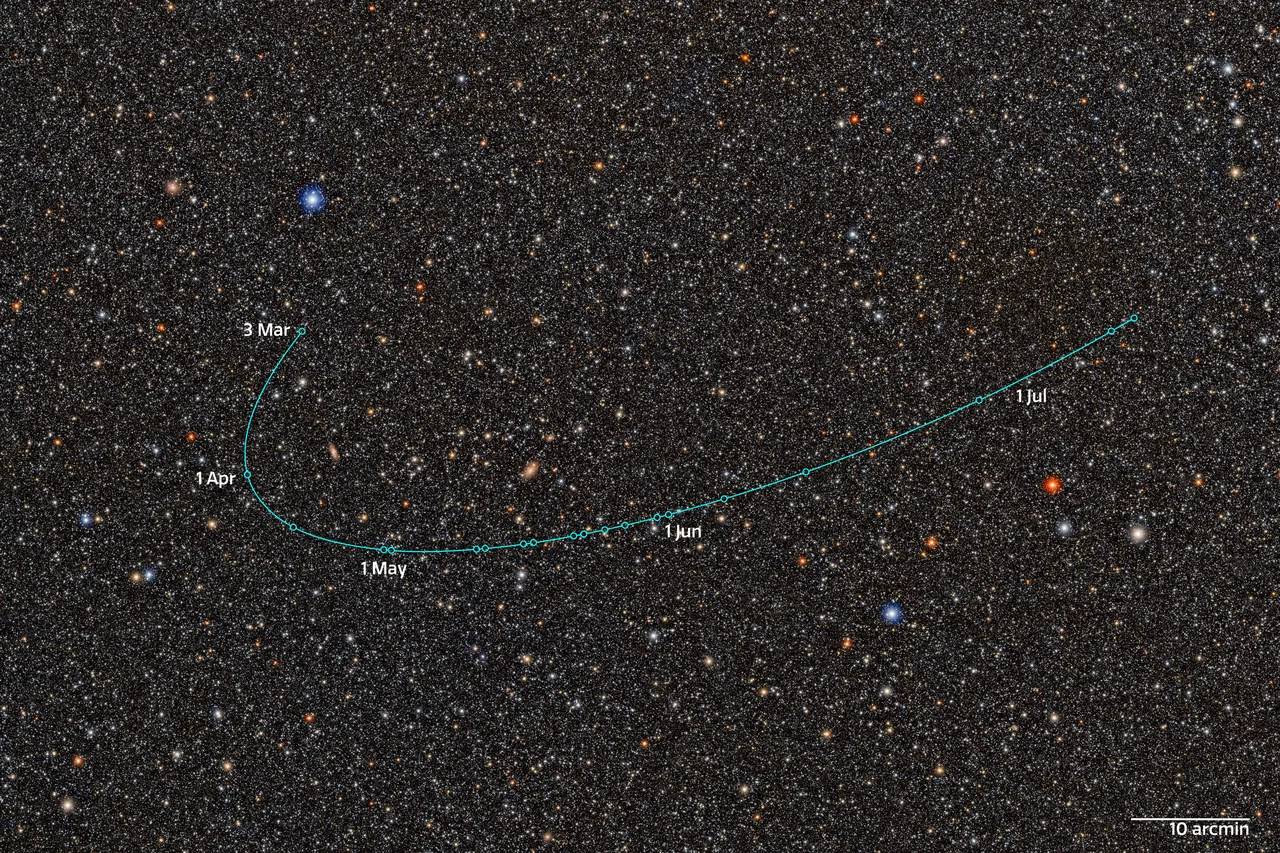
ED138 appeared in a region near the plane of the Milky Way, crowded with stars. Detecting a small moving object against that background is challenging. Rubin combines repeated observations with algorithms that connect detections.
The official video embedded here shows a model of its orbit. It is a scientific animation, rather than close-up footage of the newly identified world. The photograph accompanying this article is a composite of observations, not an invented view of its icy landscape.
Watching that distinction helps us understand what the instruments can actually show and what scientists infer from the information they collect.
Keeping room for wonder
Follow-up observations will help researchers understand ED138. Meanwhile, we can watch the video, read the original release and share the discovery with someone curious, perhaps someone who thinks science has already explored everything.
For a believer, wonder at the sky can also become gratitude. That is a reflection we bring to the story, respecting the questions and methods of scientific research. Creation continues to offer opportunities to observe, study and marvel.
Its awkward provisional name already leaves us with a lovely reminder: even close to home, when home means the Solar System, there is still so much to discover. We will follow official updates as researchers test their first ideas against new measurements.
Source: NSF–DOE Vera C. Rubin Observatory / NOIRLab / SLAC / AURA ↗