Looking for galaxies, it found a comet: Euclid’s surprise makes us look up
A bright streak in the images, software that recognises it and an object never catalogued before. C/2026 S1 is the first new comet discovered by the European telescope.
In a photograph of deep space, a streak might look like a detail to clean up. For an astronomer it can be the beginning of a discovery. That is what happened with Euclid, the European Space Agency’s space telescope, which observes distant galaxies.
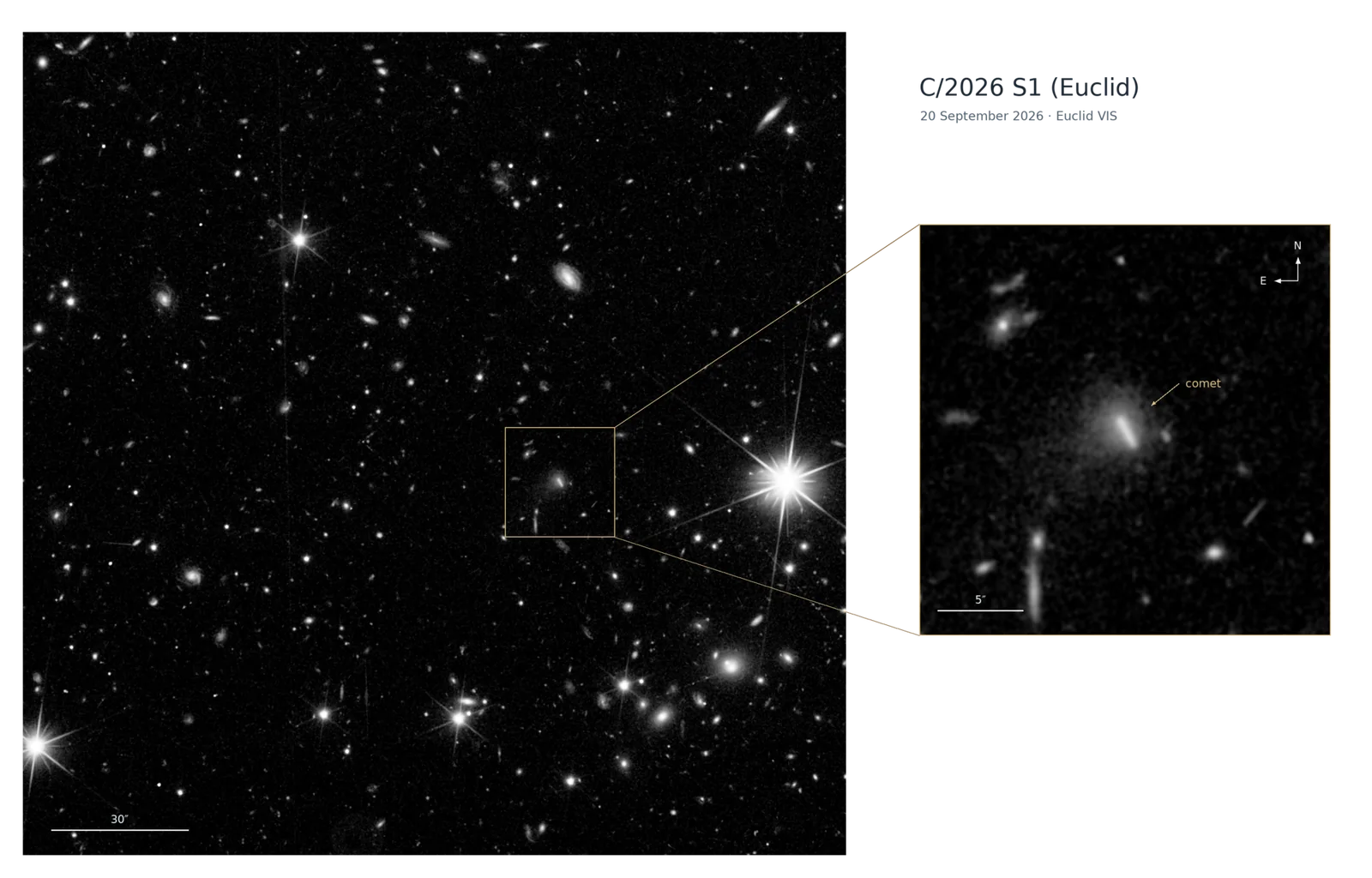
An object in motion, surrounded by a halo, appeared in images collected between 16 and 24 September 2026. It was a comet missing from the catalogues: C/2026 S1 (Euclid). Confirmation from the Minor Planet Center came on 8 October; ESA announced the discovery on the 19th.
The clue was a trail among the galaxies
Mikko Pöntinen of the University of Helsinki identified the streak using software developed to recognise moving small bodies in the telescope’s images. The object appeared in several observations of Euclid’s northern deep field.
Why does it look like a streak? During an exposure, the comet moves relative to the distant sources in the background. The photograph records that motion. A diffuse cloud of gas and dust, called a coma, is also visible around the nucleus: a clue that the comet is active.
Before naming it, scientists need to be sure
A moving object might already be known. The team therefore compared the observations with asteroid and comet catalogues. Finding no match, it reported the candidate to the Minor Planet Center, which collects and checks observations of small bodies in the Solar System.
Other astronomers could then look for it from Earth and contribute new measurements. This is the patient side of wonder: a discovery becomes robust through checks, comparisons and shared work. Euclid had already observed known comets; this is its first previously unknown discovery.
A traveller far away
According to ESA, the comet is around 1.3 billion kilometres from Earth. Its orbit extends far outside the plane in which the planets move, and a complete journey around the Sun takes thousands of years. Further observations will help refine it.
To meet this comet, we rely on images from space instruments: naked-eye visibility has not been announced. That is the beauty of these observations: they bring us a detail of the sky we could not reach on our own.
Watch it move in the actual images
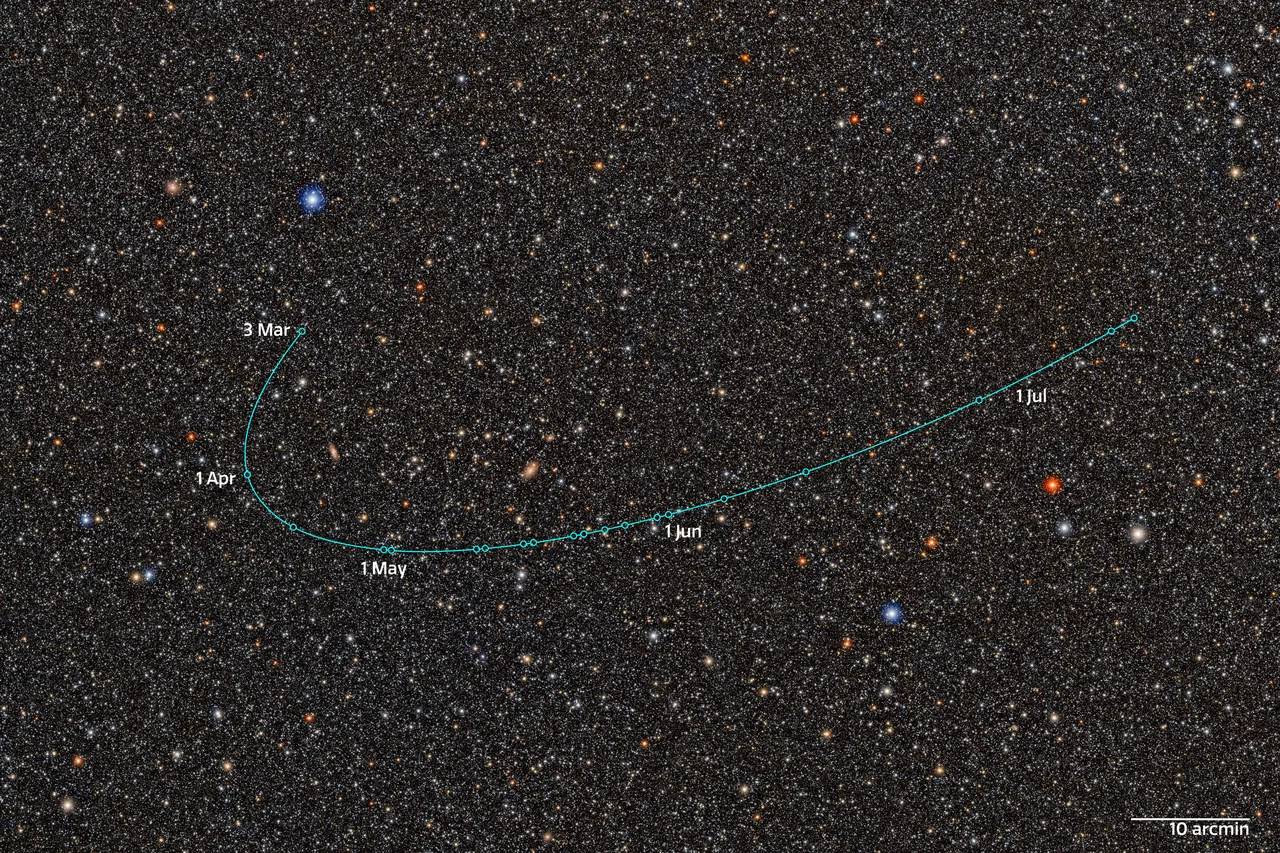
The ESA sequence below shows the comet changing position relative to the background stars and galaxies. It is a sequence of observations, rather than a cinematic recording of its journey.
Euclid had another job
The mission studies the Universe through the distribution and properties of billions of galaxies to better understand the effects of dark matter and dark energy. It focuses on immense distances, while comets and asteroids belong to our cosmic neighbourhood.
This discovery reminds us how much it matters to notice what falls outside our expectations. For someone who looks at creation with faith, knowing a little more about that sky can become gratitude: for the beauty that exists and for human intelligence learning to recognise it.
The next time you look up, you may not see C/2026 S1. But you will know that a journey continues up there, one that has only just entered our maps. And that small streak will already have changed something in the way you look.
How Euclid observes the sky
ESA’s educational video from 2023 uses animation to illustrate the telescope’s observing method. It helps explain the mission and does not depict the new comet.
Source: ESA ↗