WHERE DOES SOLAR WIND COME FROM? A SPACECRAFT FOLLOWS THE CLUES!
Solar Orbiter investigates particles streaming from the Sun. A magnetic “curl” may reveal their starting point.
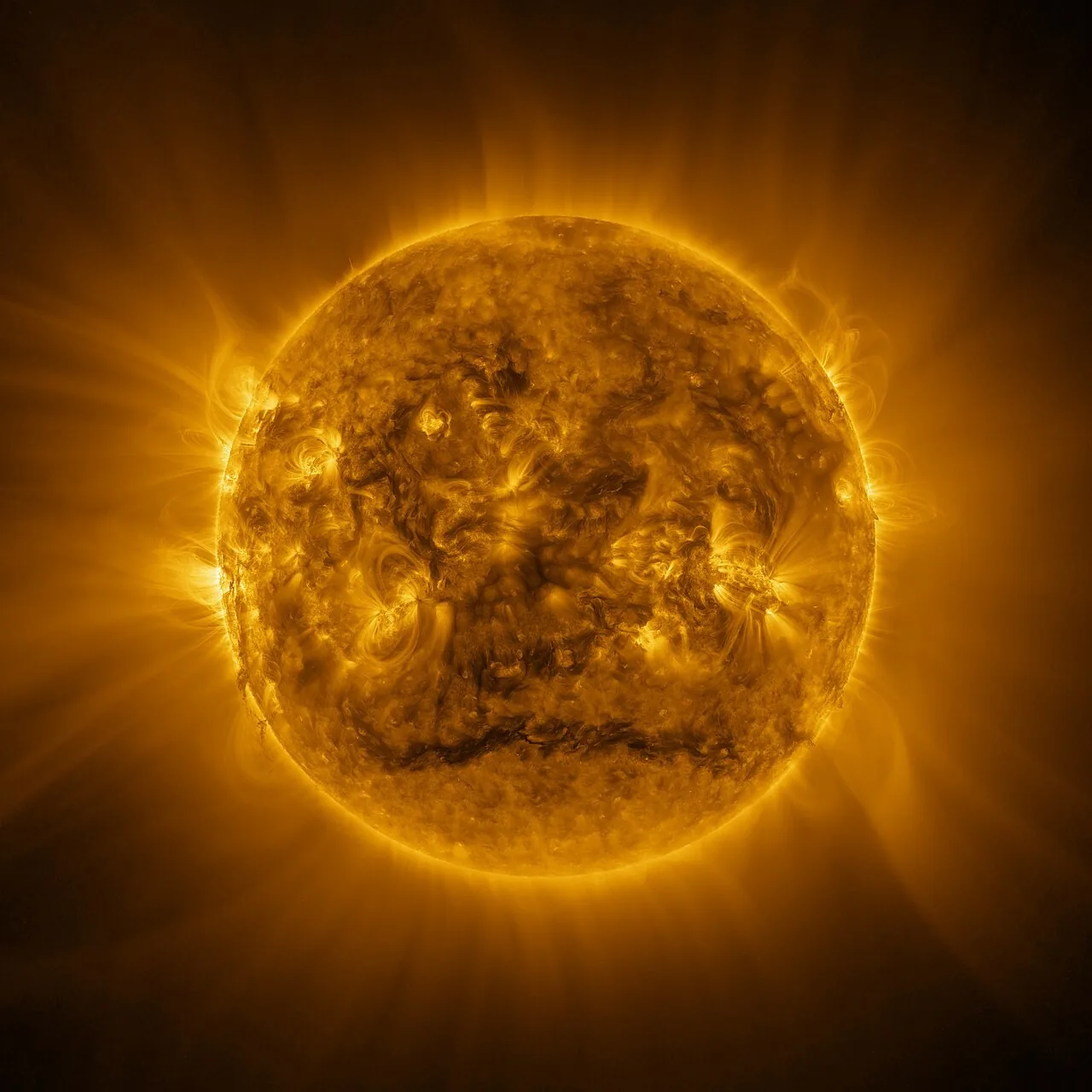
Ever wondered which shore a washed-up bottle came from? Solar Orbiter asks a similar question about solar particles. A study published in Nature Astronomy on 8 October 2026 follows a “switchback”, a bend in the solar wind’s magnetic field.
A wind without air
Solar wind is charged particles flowing through the Solar System. Sometimes its magnetic field suddenly changes direction, forming a switchback. Helios spacecraft observed these in the 1970s; Parker Solar Probe has encountered many close to the Sun.
Oxygen and carbon: key clues
Jesse T. Coburn’s team analyses measurements made a little beyond halfway from the Sun to Earth. Oxygen, carbon and low helium in the particles suggest origins in extremely hot magnetic loops in the solar corona. A model using another observatory’s images helps reconstruct their source.
A door opens
Loops usually curve back towards the Sun. They can meet outward-pointing structures and reorganise, releasing previously trapped matter. The data support this mechanism in the studied case, while waves and turbulence also play roles along the journey.
Observing and measuring together
Solar Orbiter combines instruments observing the Sun with those analysing passing particles. In 2022 it imaged an S-shaped coronal structure; the new study adds information about these flows’ composition.
In 2024, work with Parker Solar Probe showed magnetic waves energising solar wind. The mystery continues: how many other bends hide the same story?
SOURCES AND FURTHER READING
- ESA — Solar Orbiter tracks origin of mysterious magnetic switchbacks
- Nature Astronomy — elenco ufficiale degli articoli del 2026
- Northumbria University — abstract dello studio di Coburn e collaboratori
- ESA — Solar Orbiter solves magnetic switchback mystery
- ESA — Solar Orbiter’s instruments
- NASA — NASA, ESA missions help scientists uncover how solar wind gets energy
- NASA — Switchbacks science: explaining Parker Solar Probe’s magnetic puzzle
- NASA Technical Reports Server — Observation of a magnetic switchback in the solar corona
- ESA — Solar Orbiter shows how solar wind gets a magnetic push