Could animals be 200 million years older than we thought?
Animals may have appeared much earlier than the oldest known fossils suggest, perhaps 800–700 million years ago. A new study revisits an important clue: not finding a fossil does not always mean the animal did not exist.
If you cannot find your keys, you cannot conclude that you never had them. Reconstructing the history of life takes far more than an analogy, of course: rocks, fossils, DNA and patient comparisons. But the question remains: how much can we infer from something we cannot find?
The problem: fossils do not tell the whole story
The earliest animals had small, often soft bodies, without strong bones or shells. Leaving a recognisable trace in rock was far from certain. Researchers therefore compare fossils with “molecular clocks”: estimates based on differences in DNA and how quickly they accumulate over time.
These two approaches do not always agree. Molecular estimates can place the origin of animals well before the earliest definite fossils. Part of the debate concerns sites such as Weng'an in China, about 590 million years old, which preserve tiny details but do not provide definitive evidence of the animals researchers might expect to find.
A comparison that changes the question
A team led by Orin Lole Durbin and Ross Anderson also studied the Kheseen deposit in Mongolia. It is younger than Weng'an and preserves microscopic organisms in remarkable detail. Yet animals are absent, even though their existence at that time is documented elsewhere.
The point is not that scientists have discovered an 800-million-year-old animal in a rock. It is that even deposits capable of preserving very fine details may fail to record animals that lived at the time. Their absence alone is not enough to rule them out.
Perhaps 200 million years earlier
After reconsidering this limitation, the authors suggest that animals may have originated around 800–700 million years ago, up to about 200 million years earlier than certain estimates based on missing fossils. This possibility is consistent with molecular estimates; it is not a proven date.
The study was published in Science Advances. More evidence will be needed: additional deposits, identifiable fossils and comparisons between methods. So far, the researchers have not found an animal body dating back 800 million years.
What about the picture?
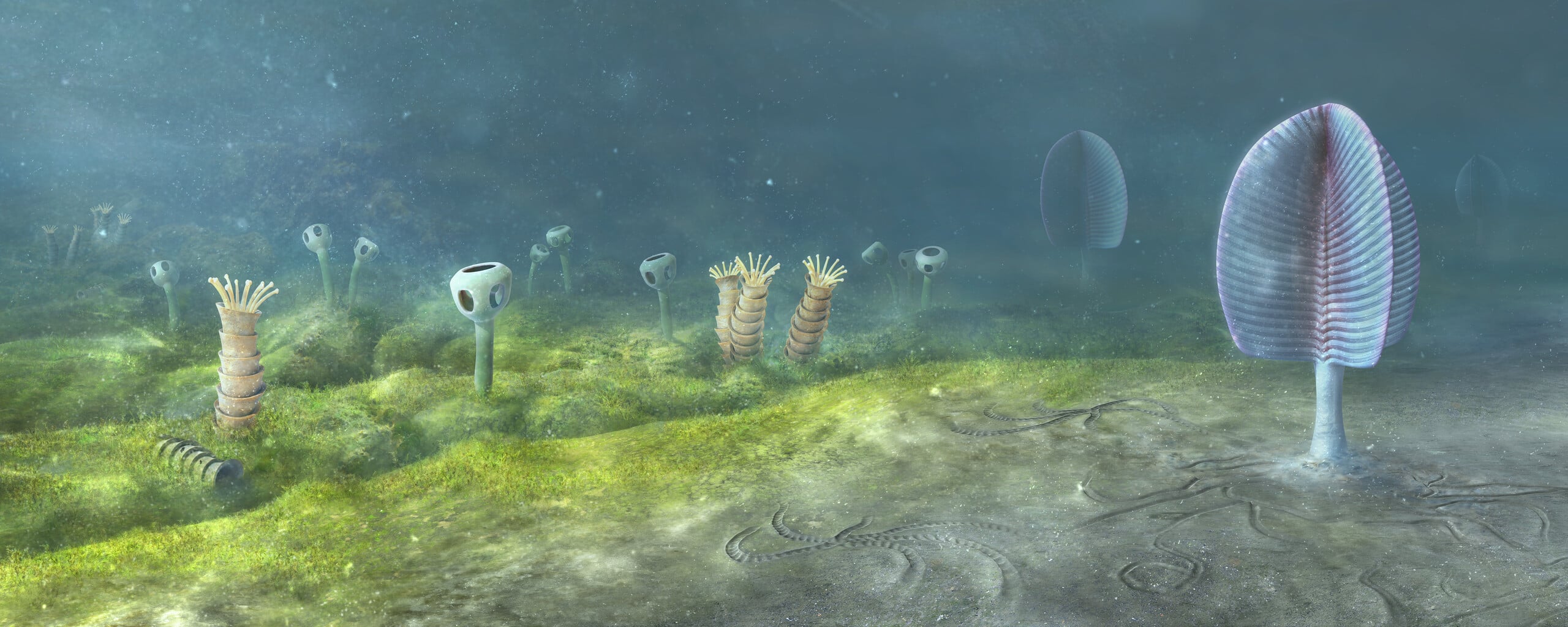
It is a scientific reconstruction of a 543-million-year-old Ediacaran seabed in Namibia, created by Mighty Fossils for the University of Oxford's Museum of Natural History. It illustrates an ancient world; it is neither a photograph nor evidence for the 800-million-year hypothesis.
Keep exploring nature in Wow, che creato!.