HE HAD A CAREER. THEN A PRISON CELL CHANGED HIS LIFE
On October 23 the Church recalls Saint John of Capistrano. Giurista, then Franciscan: his turning point was born during his imprisonment. A vocation story, within a fifteenth century to be known without simplifying it.
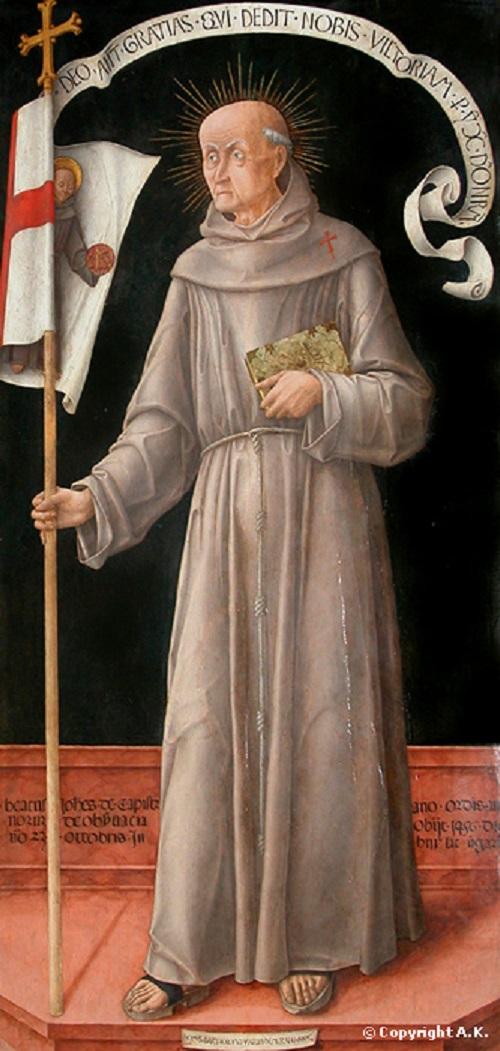
First there were law studies, public tasks, a road that seemed already drawn. Then comes imprisonment. John of Capistrano, the man accustomed to having a role in the administration of justice, finds himself deprived of freedom. The turning point of his life begins right there.
On 23 October, the Church recalls him as a Franciscan priest and patron of the military chaplains. But to get close to him it is worth returning before the saio: the Abruzzo boy who had studied, worked and imagined a different future. His vocation goes through a painful interruption of that project.
From Capestrano to Perugia, with the right in the head
Giovanni was born in Capestrano, near L'Aquila, on 24 June 1386. He trained in Perugia and began his legal career. The ecclesial biographies present him as a lawyer and governor; the reconstruction of the Biographical Dictionary of the Italians documents, more precisely, a civil judge's office in 1413–1414.
It's a useful detail for imagining it in its environment. Before preaching there are rules, decisions, public responsibilities. John enters religious life with that formation: the change of the road does not cancel out what he has learned. The acquired skills continue to accompany him.
For us, too, it can be an interesting question, when a new choice seems to make years of study or work unnecessary. What do we do? What of that experience can serve elsewhere? Changing direction doesn't force us to pretend to be born yesterday.
Prisoning is a choice that takes shape
The detention is located inside the political conflicts that cross Perugia. The reconstructions do not coincide in every detail: for this reason it is more serious to stop at the shared core, without turning the name of the jailers into a certainty. During the imprisonment the religious turning point matures.
The hagiographic sources also narrate visions of St. Francis. They are tales of biographical tradition, to be recognized as such. The decisive fact of the next journey is the entry into the Franciscan community of Monteripid, near Perugia, after the liberation.
Its history does not allow us to say that every suffering automatically leads to something good. However, it allows us to meet a person who, through a crisis, chooses another form of life. Recovered freedom also becomes the opportunity to respond to a call.
A saio and many kilometers ahead
John becomes a friar and priest, dedicated himself to the preaching and renewal of the Order. In the squares and cities he meets people who live in a society very different from ours, marked by religious and political tensions closely interwoven.
The connection with Bernardino da Siena is an important part of his journey. John shares his devotion to the Name of Jesus, represented by the monogram IHS, and supports him when he must defend himself from the accusations directed at his preaching.
Inside this friendship we also see a concrete dimension of spiritual life: having someone to share what matters. Faith can find support in a person who helps us to understand, listens and knows how to stay close when a choice becomes difficult.
A figure of his time, with painful pages
Knowing John also requires recognition of the hardest aspects of his activity. He was inquisitor and participated in initiatives against Jewish communities. Treccani documents his involvement in the trials of Wroclaw of 1453, concluded with death sentences and expulsions.
These pages should not be rendered invisible to build a reassuring portrait. Religious persecution causes real suffering; reminding them is part of an honest record. Liturgical memory and historical research have different questions, but a journalistic biography must also leave room for painful facts.
Belgrade and the last few months
In 1456 John was involved in the Christian mobilization against the Ottoman siege of Belgrade. He died on 23 October of the same year in Ilok, Croatia. The biographical tradition links death to the plague contracted after that campaign.
The title of patron of the military chaplains, attributed to him in 1984, today also recalls the spiritual presence alongside people exposed to war. Telling that historical context does not mean proposing religious conflict as a model for the present.
The question that remains, beyond the biography
John gives us a complex affair. In his path there is a moment on which we can stop: when the public role fails, he must rethink his own existence. For us, who often describe ourselves through what we do, it is a close question.
If today a road has stopped, you do not need to have a new project to perform. You may need to ask for help, catch your breath, listen to someone trusted. Even in faith we can bring a question still open: Lord, from here, what step can I take?