KAROL WOJTYŁA: WORKER, ACTOR… THEN POPE!
Underground theatre, factory work, journeys around the world and difficult encounters. Meet John Paul II before and beyond the crowds.
Before the crowded squares came a quarry, then the Solvay factory. Before speeches to the world came an underground stage. During the Nazi occupation of Poland, young Karol Wojtyła moved through these places while trying to keep studying.
A youth interrupted
Born in Wadowice on 18 May 1920, he lost his mother in 1929, his brother Edmund in 1932 and his father in 1941. He entered Jagiellonian University in 1938, but occupation closed it. From 1940 to 1944 he worked to support himself and avoid deportation. In 1942 he began attending the secret seminary while acting with the Rhapsodic Theatre. Study, work and culture needed hidden routes to survive.
The pope with a suitcase
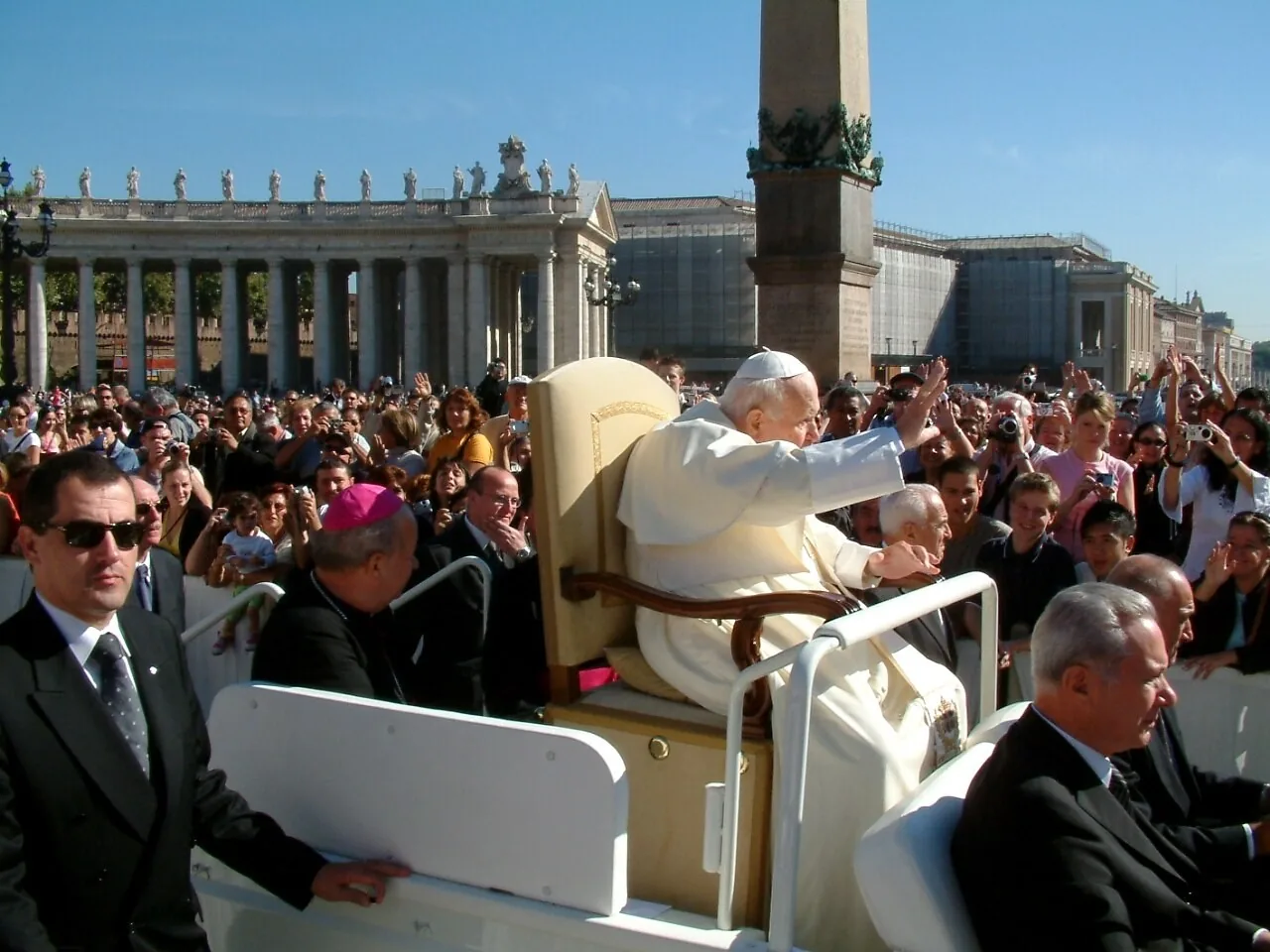
Elected on 16 October 1978, he made 104 international apostolic journeys and 146 pastoral visits within Italy. After Rome’s great youth gathering in 1985, he announced World Youth Day, creating a new Church appointment.
On 13 May 1981 Ali Ağca shot and wounded him in St Peter’s Square. On 27 December 1983 he visited Ağca in Rebibbia prison and renewed his forgiveness. This personal gesture didn’t erase justice or require other victims to follow it.
A historic step
On 13 April 1986 he entered Rome’s synagogue, welcomed by Rabbi Elio Toaff. His speech addressed a painful past, condemned discrimination and antisemitism and recalled the path opened by the Council. Read it in full: there’s a much longer history behind that famous photograph.
He died on 2 April 2005, was beatified in 2011 and canonised in 2014. His pontificate still needs study, including its hardest questions. Religious recognition doesn’t close historical enquiry.
Start with the official biography, his Rebibbia address and his synagogue speech: occupied Poland, a personal act of forgiveness and an encounter between communities. Three windows into one life.