Free Palazzo Marino tours, behind the windows on Piazza della Scala
The façade opposite La Scala is the younger face of the palace. Book a free visit to see its sixteenth-century courtyard and the rooms where Milan still runs its affairs.
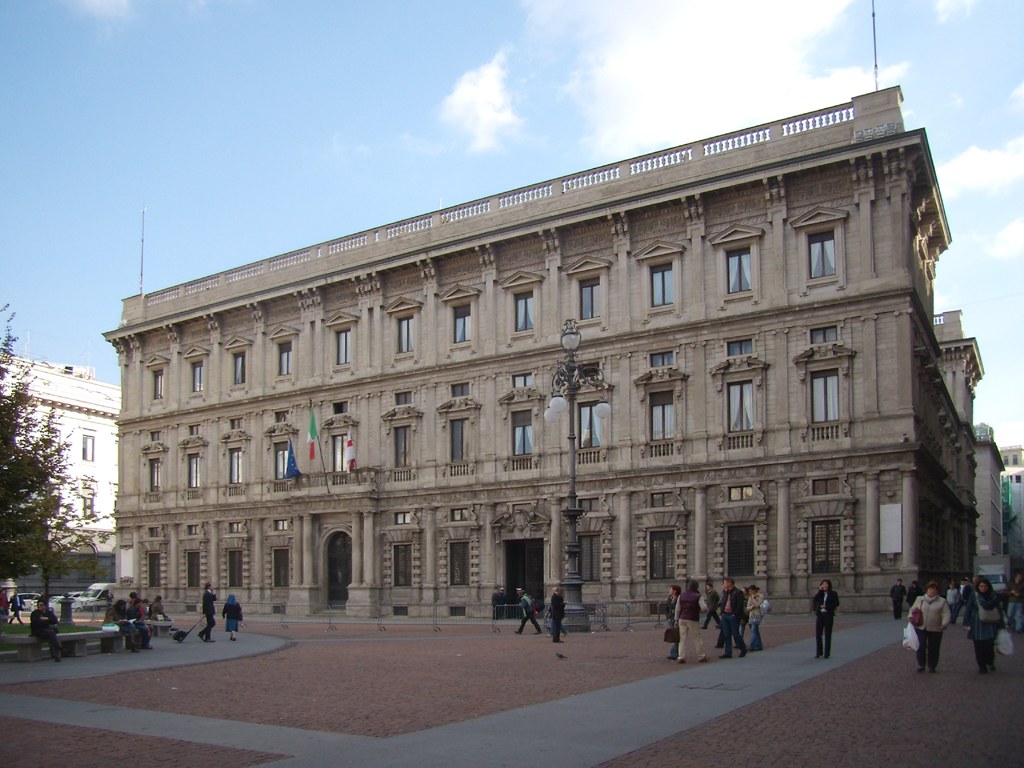
Leonardo’s statue stands between La Scala and city hall, a few steps from the Galleria. The entrance from the square is at number 2, with a free Palazzo Marino booking. Keep the email for your time and meeting point. Schools, associations and groups have separate booking pages in the same service. From Duomo on the M1 or M3, walk through the Galleria. The fare is separate, as is the ticket to the La Scala Theatre Museum if you visit both on the same day. Before showing your booking, it is worth going around the corner of the palace.
When the palace turned towards La Scala
Palazzo Marino takes its name from Tommaso Marino, a Genoese merchant who made his fortune in Milan and commissioned architect Galeazzo Alessi to design his home. Work began in 1558. If you come through the Galleria, though, the first façade you see is the younger one. Luca Beltrami completed the Piazza della Scala front in the late nineteenth century, when the building was already city hall. The original main façade faced Via Marino. If you have time before the tour, walk round the corner. You can see how the building came to address a different part of the city.
The façade facing La Scala was built with ceppo del Brembo, a stone that wears with age and shows where water has run. The restoration began with Beltrami’s façade and was completed in 2025. From Piazza della Scala there is room to take in the whole design. The narrow street on the Via Marino side brings you much closer to the walls. A few steps change both the façade you are looking at and the distance from which you see it.
If there is a queue for the Christmas exhibition in the square, check the meeting point in your email. The exhibition and the tour of the rooms can use different entrances. For the 2026 first-Sunday visits organised with Fondazione Bracco, the March 1 to December 6 series is fully booked. Look for new dates in that calendar. On other days, start with the city’s individual bookings, where you can also ask about step-free access on your tour.
What the courtyard kept
The room also tells you what Milan had to rebuild. Bombing in 1943 severely damaged the palace and the Sala Alessi was among the rooms hit. Much of the sixteenth-century arrangement and decoration of the main courtyard survived. If you want one thing to look out for before you enter, the city’s short film about the Sala Alessi shows the doorways and gives you a sense of how high the paintings are from the floor.
Source: Comune di Milano – InComune ↗
In Sala Alessi, your hand goes to the door and your eyes can stop at the same height. Mars and Minerva are directly above the doorways. From there, the story continues along the cornice through the Muses, Apollo, Bacchus and Mercury. That part of the room is easy to miss if you walk in looking straight ahead. It comes back into view as soon as you look up.
The courtyard has one story running along its walls, and another above it in the rhythm of the loggia. The reliefs show scenes from the Labours of Hercules and Ovid’s Metamorphoses. At a distance they can look like one continuous pattern. A figure seen close up lets you follow a gesture and pick it out again beside the others. It takes the short time between stepping into the courtyard and starting to notice what’s there.
Indoors you can step from one century to another simply by crossing a threshold. In the Sala delle Tempere, the walls are decorated to resemble Cordovan leather and marble. In the Sala della Trinità, there are frescoes transferred from the Milanese church of San Vito in Pasquirolo. If an artwork catches your eye, ask the guide where it came from. Some of the things that tell you the most about city hall started their lives elsewhere in Milan and came here later.
The room where Milan has its say
In the Sala della Giunta, on the square side of the building, the beamed ceiling and walnut floor give the route a different character. Three frescoes by Tiepolo came from Palazzo Dugnani. Later, after the loggia, the Sala dell’Orologio brings Renaissance-style furnishings together with fourteen seventeenth-century paintings. The two rooms are good points of reference if you lose track of where you are as the tour moves between offices of government and formal reception rooms.
In the council chamber, the semicircle and the galleries for the press and public show you who speaks and who listens. Ambrogio Figino’s Saint Ambrose on horseback hangs on the wall. The painting has a story of its own. Below it is a room in which the city still holds meetings. Palazzo Marino has been the seat of the administration since 1861. You can see the difference between Tommaso Marino’s home and Milan’s city hall simply by looking at how the seats are arranged.
Back by Leonardo’s statue, look for the windows of the executive chamber. On the way in, you might have counted them as just another row overlooking Piazza della Scala. Now you know there are three Tiepolo frescoes behind them, a walnut floor and a room where work gets done. That is the detail I would keep from the visit. The façade built to present Milan to the city has a working life behind it.
SOURCES AND FURTHER READING
Did this story touch your heart?
Psst… you’ll like this too!
In Ortica, Jannacci’s Milan and Ambrosoli’s share a street
Read the story ↗Share this story