Visit Milan’s Chiaravalle Abbey for free, church and cloister included
Choose a Saturday morning to visit without a ticket, see the tower and spend a while in the quiet. Here are the opening hours and the route from Milan.
When to go for a free visit
To visit the church and cloister of Chiaravalle Abbey for free, go to Via Sant’Arialdo 102 in Milan from Tuesday to Friday, between 9 am and noon or between 3 and 5 pm, or on Saturday from 9 am to noon. Try arriving at around 10.30 am. Saturday morning is the weekend choice for an independent visit. On Saturday afternoons, Sunday afternoons and public holidays, sightseeing in the church and cloister follows the guided tour calendar. There are separate church hours for prayer. Those hours serve worship and do not extend visitor access to the choir, transepts or cloister.
Take the yellow metro line and then a bus
Get off at Corvetto on M3 and take bus 77 to Abbazia di Chiaravalle. If Rogoredo suits you better, use M3 to get there and continue on bus 140. Check the route for the day you are going and save a departure that works for the return, too. On Saturday morning, allow enough time to reach the address well before noon. Enter the abbey entrance at number 102 Via Sant’Arialdo as your destination. The full address is particularly helpful if the people you are meeting are approaching from different stations. You can all meet at the entrance instead of guessing which part of the neighbourhood to aim for.
The independent visit is free. Metro and bus travel is charged separately unless you already have a valid ticket or pass. A standard ATM ticket for Mi1–Mi3 costs €2.20 and lasts 90 minutes from first validation. Allow for the return journey if your visit runs longer than that. If you are already in southern Milan and would rather walk, the Vettabbia route connects the Nosedo area to Chiaravalle. It makes most sense in daylight and suitable weather. The bus is the simpler option if you principally want time in the church and cloister rather than a longer walk before you arrive.
First stop, look for the Ciribiciaccola
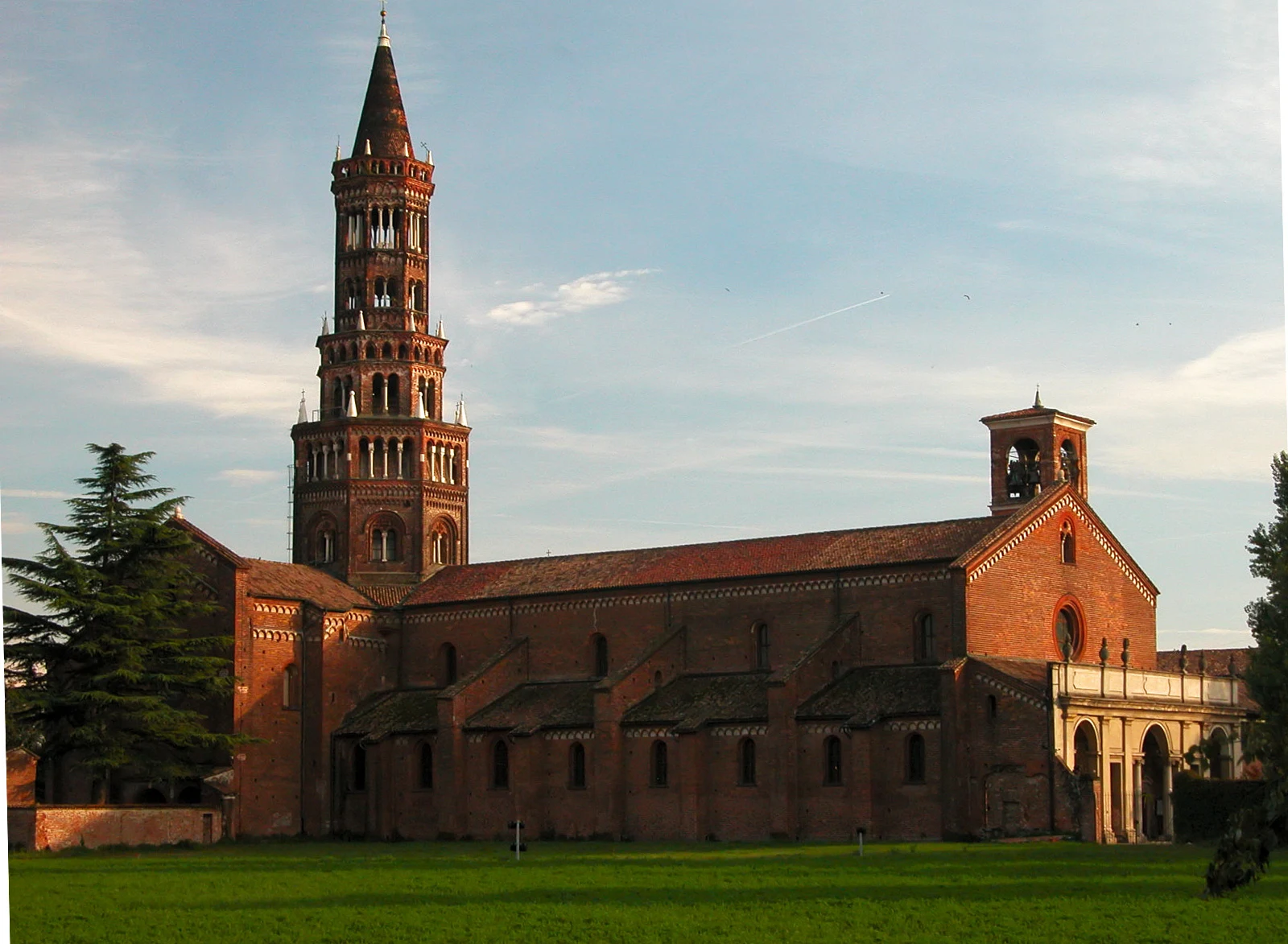
Before going inside, look up at the tower that Milan calls the Ciribiciaccola. It rises over the point where the nave and the transept meet. Stand somewhere you can see its profile and the way it narrows as it climbs. With children, take turns describing it without using the word “tall”. Try the windows, the changes from one level to the next or the contrast with the lower roofs. Looking for those details is an easy way to see how one tower changes the shape of the whole building, even if you have come without a guide or a map.
The Cistercian community began here from 1135, with Bernard of Clairvaux. The church was consecrated in 1221. The monastery is still active and lies in the Parco Agricolo Sud Milano. Look at the brickwork and the shape of the church, then imagine how the buildings would have appeared to somebody arriving on foot from the surrounding farmland. The distance from the present-day neighbourhood to the abbey is short, but it is enough to change your pace. Leave a minute between spotting the tower and looking for the door. The outside gives you a way into the story before you step inside.
Give yourself time in the church
Enter during the independent visiting hours and pause near the nave, leaving room for other people to pass. Notice how the light changes as you look towards the far end. Pick out one painted detail that is visible from the open areas and then step back to see the wall or vault it belongs to. If a service is taking place, respect those at prayer and follow the directions for visitors. If you came to pray, sit for a while and let the visit wait. This is a working church for a community that still lives and worships here.
When the cloister is open, spend a few minutes under the arcade. Follow the rhythm of the columns, then find something that interrupts that repetition, such as the knotted column. Look for the tower again from the cloister and see what changes when it is framed by the arches. The church and cloister can be accessed by wheelchair users and people with reduced mobility. If you need help with the route or want to know about another part of the complex, contact the Infopoint on +39 02 84930432 before travelling. Ask about the particular spaces you intend to visit.
What the mill and guided tours cost
The independent visit during the published hours covers the church and cloister. For other spaces, open the guided visit calendar. The one-hour church and cloister tour costs €10. Adding the mill costs €17 and takes an hour and 45 minutes. A visit that also includes the Chapel of Saint Bernard costs €22 and takes two hours and 15 minutes. A 30-minute guided visit to the chapel alone costs €7. Tour times depend on the date. Choose a route before you book. Online purchase is recommended, and if seats remain you can book until noon on the day of the tour.
The Infopoint is to the right as you face the church façade. For a guided visit, go there with your confirmation and time to check in. To keep the visit free, choose a morning with independent access and leave the mill for a separate outing. The free virtual tour lets you explore parts of the complex from home. Open it beforehand to choose details to look for, or afterwards to see spaces you did not include. There is also a video link below.
A Saturday morning without rushing
Arrive at 10.30 am, look at the tower from outside and then go into the church. Reach the cloister while the visiting window is still open. If time is short, see the church first and save the neighbourhood walk for later. If there is a child with you, ask what they want to see once more before leaving. Look up your bus before deciding whether you have time for one more view of the tower. The whole outing fits into a morning. You can take your time and be back in the city for lunch without paying for admission to the abbey.
If you are coming to pray
The church opens for prayer from 6 am to 12.30 pm and from 2.30 to 8.30 pm. For Mass and the Liturgy of the Hours, use the separate service timetable. Plan any sightseeing during visiting hours.
SOURCES AND FURTHER READING
Did this story touch your heart?
Psst… you’ll like this too!
Where to study and work for free in Milan, three libraries with Wi-Fi and sockets
Read the story ↗Share this story