In Ortica, Jannacci’s Milan and Ambrosoli’s share a street
Jannacci and Ambrosoli face the same street from opposite walls. Tram 5 takes you to Ortica, where you can walk through part of Milan’s twentieth century for free.
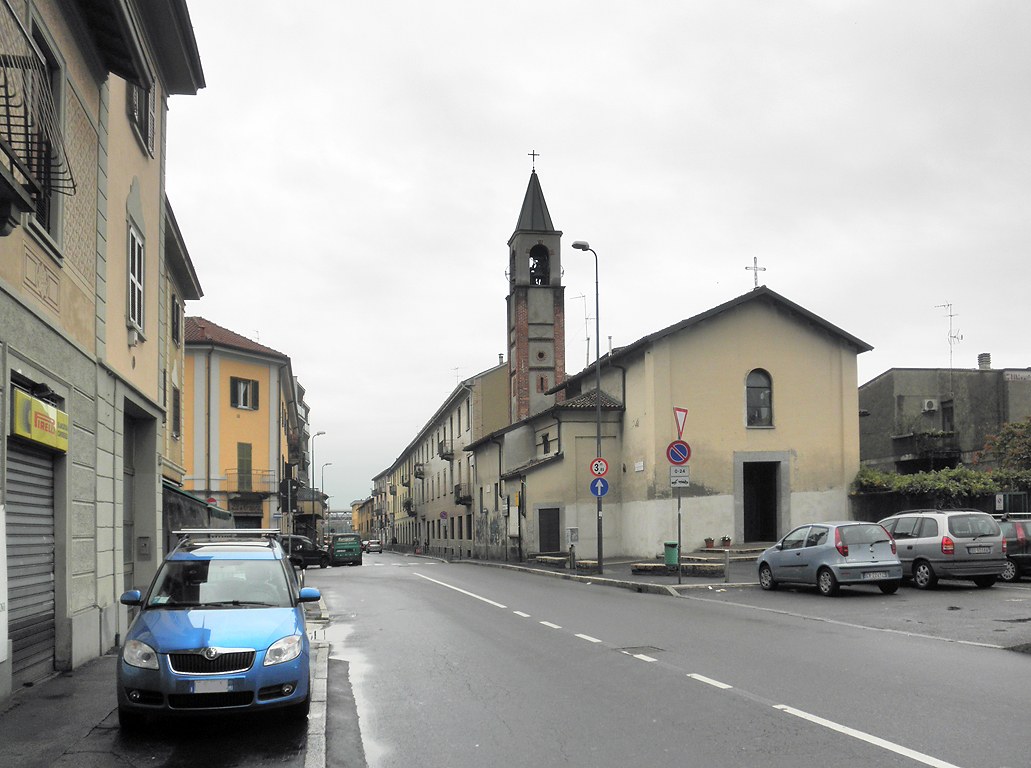
Tram 5 stops on Piazza Duca d’Aosta, outside Milano Centrale station, on its way to the terminus in Ortica. Via San Faustino and Via Ortica are enough for a first look at the neighbourhood’s murals. Jannacci is on one side of the road, Ambrosoli on the other. Further along come the builders, standing in a row as they did in the 1914 photograph. The OrMe map shows them just a few blocks apart. The murals are free to see from the pavement, with no booking. The tram fare is separate if you take it.
Who put the neighbourhood on the walls
The photograph of the builders found a home on the headquarters of the Ortica housing cooperative. The mural keeps them lined up, with two pictures of Jesus Christ and Karl Marx behind them. Move along the pavement until you can make out both pictures together. They were already in the 1914 photograph and tell you something about the members who posed. From this wall it is easier to see why the work mural on the railway embankment in Via Ortica can speak about a history closer to home than its sheer size suggests. Milan had one of Italy’s first Chambers of Labour in the late nineteenth century. Here that part of its labour history comes with faces.
Orticanoodles led the artistic work with OrMe, involving residents and local associations. You see the result in where the murals have landed, among the railway, the houses and the schools. At the turn into Via Ortica, the rights mural unveiled in 2023 stands close to Madonna delle Grazie, the old church of Saints Faustino and Giovita. The village grew around the church. The painted wall and the lower buildings bring two periods in the neighbourhood into view together. If you have time for a short walk, the stretch of Via Ortica from number 14 towards the purple bridge brings you back to its labour history.
The people Milan kept in sight
Which wall is to your left depends on how you arrive. The musicians are on the side with the warm colours. Enzo Jannacci and Giorgio Gaber appear beside Ornella Vanoni and Nanni Svampa. Ortica was already in songs before anyone put it in a mural. Those performers caught the sound of the city’s speech, its cabaret and its taverns. Their faces break across planes. Up close you can pick out each portrait, then step back to see them together.
Green dominates the other side. The portraits in the mural about the rule of law include lawyer Giorgio Ambrosoli, General Carlo Alberto Dalla Chiesa and Tina Anselmi, a member of the Resistance and the first woman to serve as an Italian government minister. Knowing who they were changes how long you spend in front of the work. Ambrosoli continued the liquidation of the Banca Privata Italiana despite threats. Dalla Chiesa was made prefect of Palermo in 1982 to fight Cosa Nostra. Anselmi went into government after the Resistance and years of union and political work. Start by picking out one name, then use the mural’s entry to match the others to their faces.
One of the other portraits is that of Judge Emilio Alessandrini, who worked on the investigation into the Piazza Fontana bombing. If you recognise the name but can’t place the face, pull up OrMe’s entry while you stand in front of it. It works a little like a label beside a painting. Across the road, though, Jannacci is still there. Their names belong to some of the same years in Milan, and here you can see them in the same place. The colours help you get your bearings when you approach from the other direction. The musicians are on the wall with the warmer tones.
For the mural dedicated to women of the twentieth century, look for the outside wall of the Istituto Pasolini school on Via Domenico Trentacoste. Unveiled in 2018, it brings together women from different walks of life. Camilla Cederna wrote for newspapers, Alda Merini and Antonia Pozzi left poems that are still read today, and Liliana Segre has spoken about deportation and the memory of the Holocaust. The portraits are a way into those stories. You can see the wall from the pavement outside the school.
When a wall becomes a cathedral nave
For the longer walk, look up 17 Via Riccardo Pitteri. The nave of Milan’s cathedral reappears here as a large painting, part of a series called “Una poesia scritta sul marmo”. Perspective is as much the subject as the cathedral. Stand where you can see the full composition and follow the lines of the nave towards the back. Then get closer and see how the illusion works on a flat wall. There’s also a short film of the inauguration that gives you a sense of the scale before you set off.
If there’s time after 17 Via Riccardo Pitteri, number 58 is the stop for “Alle arti”. You can see the painted nave by changing your position on the pavement and leaving the entrances to the houses clear. From there, pick the nearest stop for the way back. The cathedral stays among the houses. At the other end of the walk, below the railway, are the musicians and the green portraits.
SOURCES AND FURTHER READING
- OrMe · Mappa e opere dell’Ortica
- OrMe · Alla legalità
- MUDEC · Le opere di Orticanoodles e OrMe
- Orticanoodles · Alle donne del ’900
- ATM · Tram 5 per Ortica
- Nicolò Piccione · Inaugurazione del murale del Duomo
- Fotografia originale · Arbalete, CC BY-SA 3.0
- Licenza Creative Commons Attribution-ShareAlike 3.0
- ATM · Tram 5 da Stazione Centrale in direzione Ortica
Did this story touch your heart?
Psst… you’ll like this too!
Free Palazzo Marino tours, behind the windows on Piazza della Scala
Read the story ↗Share this story