Marsili, the giant beneath the sea: what scientists explain
The underwater volcano’s name is being searched again following earthquakes in the Tyrrhenian Sea. We begin with INGV’s explanation, exploring an extraordinary part of the Mediterranean without letting fear take the helm.
Some landscapes become visible only when someone tells us about them. Beneath the blue Tyrrhenian Sea, where from the coast there seems to be only water, lie mountains, geological structures and an ongoing chapter of Earth’s history. Marsili belongs to this submerged world: INGV describes it as the largest underwater volcano in Europe and the Mediterranean. That alone is enough to spark curiosity.
Recently, however, its name has been accompanied by a less peaceful question. After the earthquake sequence in the southern Tyrrhenian Sea, people want to know whether the volcano is involved. That is understandable: when the ground moves, even words can seem unstable. It makes sense to seek answers in scientists’ analyses before relying on a hastily shared headline.
The explanation to start with
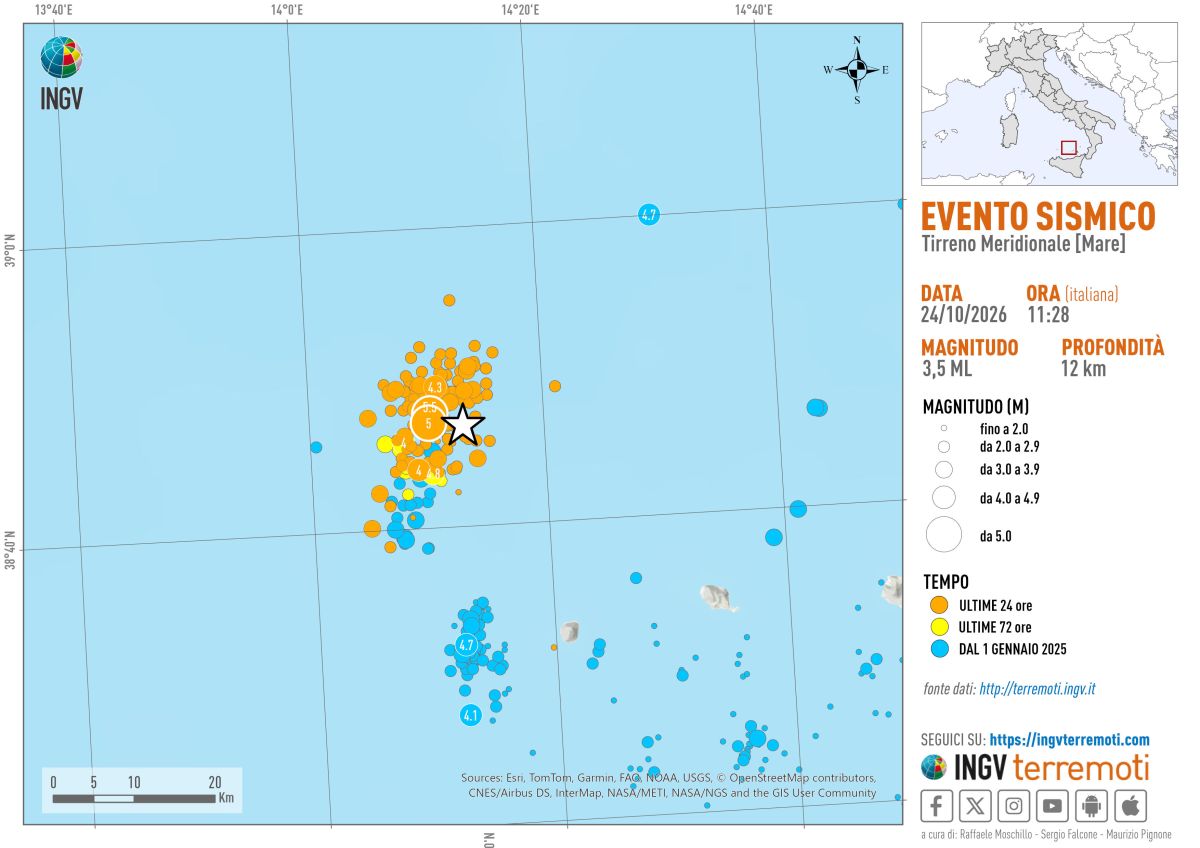
In its detailed report published on 24 October, INGV examines the sequence and its possible relationship with Marsili. Its conclusion is precise: no direct correlation is identified. The institute also distinguishes the compressional mechanism of the magnitude Mw 5.5 earthquake from the extensional setting associated with Marsili’s volcanism. These are geological explanations, not impressions based on two names being close together on a map.
The hydrothermal activity and very low-energy seismicity described for the volcano should not automatically be confused with this recent sequence. Saying that something happened at sea is not enough to establish a volcanic cause. As in many fields, geographical coordinates are where a question begins, not where the answer ends.
The map is not showing an eruption
The INGV map accompanying this article represents the southern Tyrrhenian earthquake sequence. It is not a photograph of lava under the sea and does not depict an eruption. This may sound like a small distinction, but images and words work together. Read without context, a map covered in dots can suggest a scenario different from the one its authors explain.
It helps to ask what an image represents. Epicentres? A reconstruction of the seabed? A simulation? A real survey? Visual information becomes clearer when we understand its purpose. Wonder does not diminish because an explanation is accurate. Instead, it stops relying on a misunderstanding and becomes knowledge.
Explaining is different from making promises
The studies help explain this sequence, while monitoring continues in the Tyrrhenian Sea. Scientists’ data and updates are where to look for answers about the volcano.
We can learn to look for that precision too. When we read “no direct connection”, we should not translate it into “nothing can ever happen at sea”. When we see a volcano’s name, we should not finish the sentence with “it is about to erupt”. Between those shortcuts lies room to understand the news properly.
If you felt the earthquake, your fear deserves respect
For someone who has experienced a tremor, understanding the phenomenon is only part of the issue. There is the jolt, the body remaining alert and the need to know loved ones are safe. You need not feel foolish for being frightened. We can acknowledge that reaction, then choose reliable information rather than feed it with untraceable videos or unsupported predictions.
For practical behaviour, the reference is Italy’s Civil Protection Department. During shaking indoors, it advises taking shelter beneath a beam, in a doorway within a load-bearing wall, or under a sturdy table, and avoiding stairs and lifts. Outdoors, move away from buildings and power lines. These are general instructions: follow local authorities’ directions and the local emergency plan.
Three small checks before forwarding
Look at the author: who is speaking, and with what expertise? Check the date: does this material really concern the current event? Find the original link: do the words attributed to INGV appear in the institute’s own report? These actions take a few minutes and can spare others hours of anxiety. Being well informed is a way of caring for each other.
If someone sends an alarming message, you can reply without humiliating them. “I found the official explanation; let’s look together” builds more trust than ridicule. A mistaken share may come from a wish to protect. Helping that person find a better source is already worthwhile.
The Mediterranean deserves our wonder
Marsili remains fascinating when we remove an alarm unsupported by the analysis cited here. It reminds us how much of our planet exists beyond what we see from shore. Knowing creation also means allowing it its complexity: studying it, respecting it and learning to describe it well. The sea can keep surprising us. We can learn to look with curious eyes and solid information.