A waterfall from the sky? Brazil’s natural wonder leaves us speechless!
A sweep of colour, a cave framing the sky and a trail of water that seems to fall from the clouds. At Casa de Pedra in Brazil, there’s a scene worth watching twice. With plenty of wonder, and a few questions.
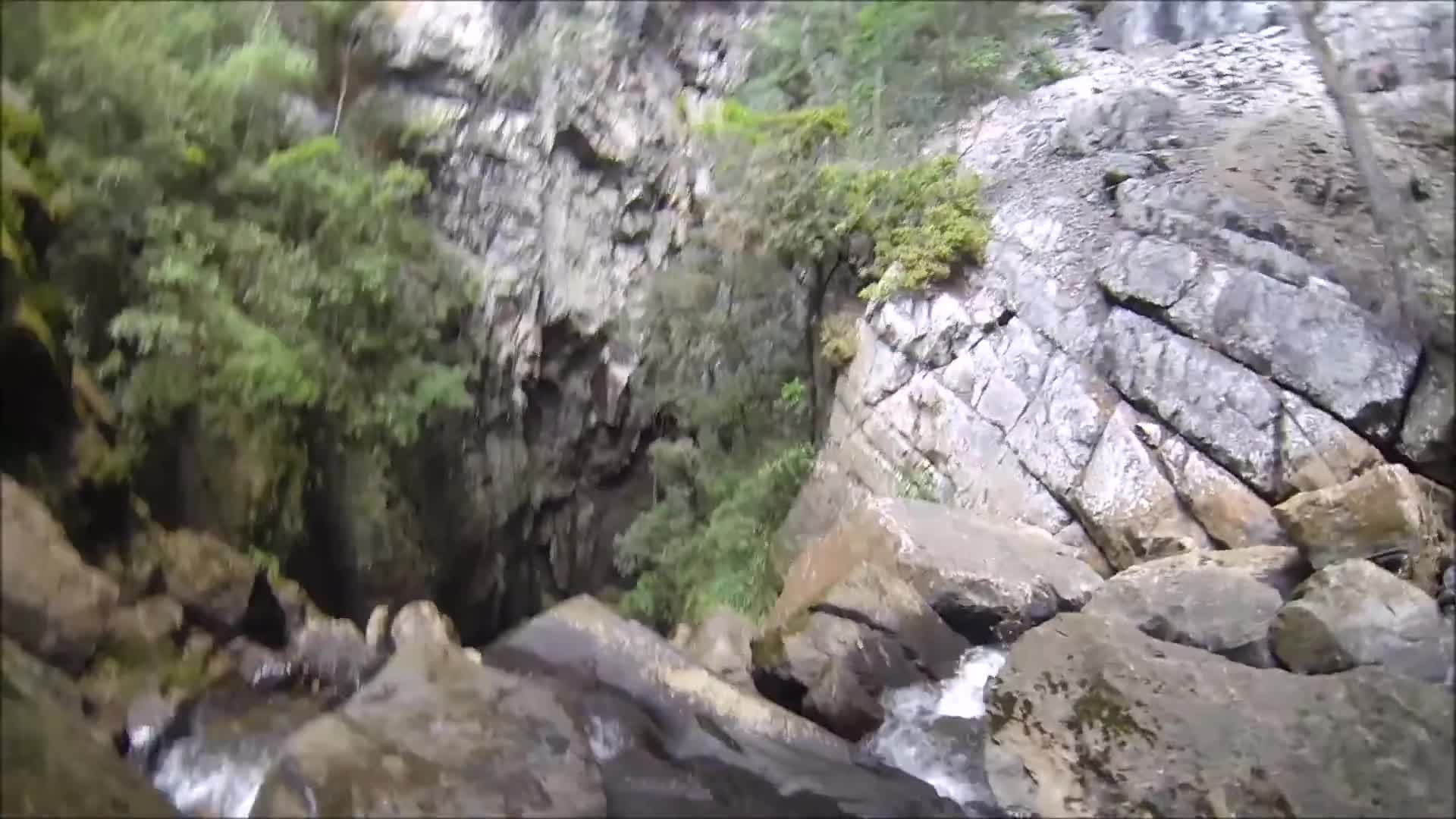
Some images stop your scrolling finger. First you notice the colours, then that pale streak in the middle, then you try to work out where the rock ends and the sky begins. And you start again. Because it really does look as though someone up there has turned on a tap among the clouds.
In the footage, a bright arc meets a vertical streak. Dark rock and vegetation frame the blue sky. Your eye keeps returning to the stone, the light, those colours that seem to hang in the air. Do you want to watch it again too?
The place is real: welcome to Casa de Pedra
We are in Iporanga, in the Brazilian state of São Paulo. The footage is credited to Giba Morais, known on Instagram as @gibamorais_omestredosmatos: the name to look for if you want to find the person behind these images.
Casa de Pedra is in the Parque Estadual Turístico do Alto Ribeira, or PETAR. São Paulo state’s official protected-areas guide describes an enormous rocky entrance surrounded by Atlantic Forest. Near the opening, the Maximiano River forms a natural pool and a waterfall that enters the cave. Water really is part of this landscape: the viewpoint creates a surprising connection between it and the sky.
Does that bright streak really come from the clouds?
It looks like a waterfall suspended in the air. Mist and water droplets can create striking optical effects, but the footage alone cannot explain exactly what produced that vertical streak. For now, we can admire it and keep the question open.
Watching the footage, we can describe what we see: a bright, speckled trail against the sky, visually crossed by the coloured arc. Reconstructing the position of the water and the path of the light from this single perspective would require more information. Curiosity can stay open even after we press play.
A rainbow or a halo? Light knows how to surprise us
The arc around the Sun resembles a solar halo. Identifying the phenomenon with certainty would require more precise observations of the atmospheric conditions. The video gives us a spectacle and a fascinating science question.
The general explanation of halos, however, is well understood. As the Met Office explains, ice crystals in high clouds can bend light and produce bright arcs or rings. In the common 22-degree halo, the geometry of hexagonal crystals determines the ring’s angular distance from the Sun. A tiny ice structure helps draw something enormous across our view.
A rainbow, by contrast, forms when light interacts with water droplets through refraction and internal reflection. Similar colours can therefore have different origins. Identifying them depends on the Sun’s position and the direction we are looking: a colourful arc alone is not enough to give it a name.
A window onto creation, even through our phones
Here on CHIARA!, the reel lets you return to the scene, look at the details and follow the link to Instagram. Try watching it a second time: follow the edge of the rock first, then the arc, then the droplets. Your eyes search for a pattern and discover something they missed the first time.
For a believer, beauty like this can also become gratitude. A small, spontaneous thought of God, before a world that keeps surprising us. That is our response to the scene, the way we receive it.
It brings to mind St Francis’s way of seeing creation: calling the sun and water brother and sister, close to our lives. Perhaps attention is where we can begin again. Light on a wall, a wet leaf, a changing sky on the way home.
This time, the “wow” comes from a Brazilian cave. And it leaves us with a wonderful urge: to look up beyond the screen.