Aureo 1618: “My challenge is making room for God”
Music, love and the desire to tell his story. Aureo 1618’s creator tells CHIARA! how his songs take shape, the role of artificial intelligence and a faith that is part of his creative journey.
“I’m not looking for numbers. I’m looking for resonance.” That is how Aureo 1618 introduces his project. When we ask what it means to see a song reach someone, he tells us about messages from listeners who recognised themselves in his words, or thanked him because a track had accompanied their day. One of the things that moves him most is discovering that a story drawn from his own life can speak to someone else’s.
He tells CHIARA! about the experiences he writes from: love, encounters and questions that keep returning. His independent Italian alternative-pop project brings together emotional writing, cinematic atmospheres and artificial-intelligence tools. We ask him to take us inside his songs. He also tells us where God fits into all of this.
The curiosity to try, the pleasure of creating
Who is Aureo beyond the music? He works in a different field and describes himself as curious, sensitive and sometimes restless. “I’m someone who tries things, experiments, sometimes gets things wrong and often questions himself.”
Asked whether he remembers the precise moment he decided to write a song, he says there was no single incident. He had long felt he had a lot to express, without always managing to do so. “I’m not a traditional musician. I haven’t spent years studying an instrument. But I had something to say.”
He remembers the surprise of that first listen: an emotion he knew well had become a song. “It was like finally giving it a voice.”
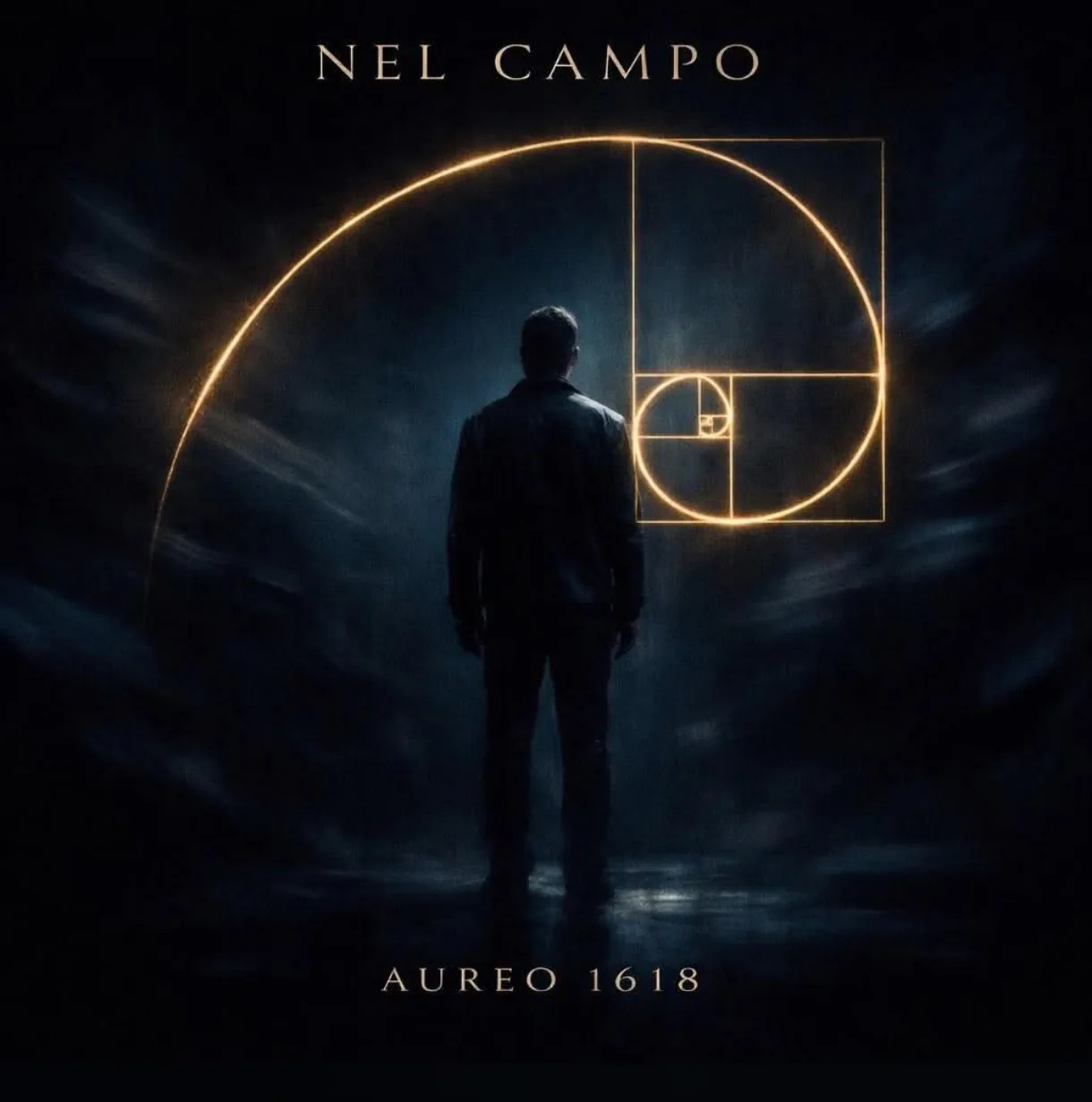
The name Aureo 1618 refers to the golden ratio, the number 1.618. He is fascinated by the search for harmony that can embrace imperfections. “Life isn’t always symmetrical. There are cracks, contradictions, moments of light and moments of darkness.” The project’s symbol, an A crossed by the golden spiral, represents this continuing search.
A great love, inside “Non resta mai”
“Non resta mai” grew out of a reconnection with someone Aureo considers a great love of his life. He tells us how intense that moment was, and how difficult it was for them to stay together.
“Every time we seemed to find each other again, something would pull us apart once more.”
That “it never stays” referred to them. It later took on a broader meaning: “Love doesn’t always last, but neither do joy, beautiful moments or the seasons of life.”
Among the responses he remembers is one from Doriana, a music curator. She described the track as if it held its emotions inside a small shell of intimacy, almost to protect them. She knew nothing of the love story behind it. Her interpretation surprised and moved him.
“When someone can sense all of that without knowing the story, I realise that the music has crossed a distance. And it’s a wonderful feeling.”
The courage to be honest with yourself
For readers discovering him today on CHIARA!, Aureo recommends “Solo un istante di verità”. He feels it reflects one of the project’s central ideas: the desire to encounter something authentic, even when the truth is uncomfortable.
We ask whether a song has allowed him to say something he could not even admit to himself out loud.
“Perhaps the difficulty of being completely myself.”
Aureo describes resisting a change to a familiar situation even when it no longer makes him happy. “Solo un istante di verità” grows out of that difficulty.
“It doesn’t mean having all the answers. It means being able to look at yourself without running away.”
He suggests listening closely to the spaces between phrases too: “Sometimes a pause says more than an entire verse.”
He also recommends “Non resta mai”, which reveals a side that is “more vulnerable, less resolved”. “They are two different ways of expressing the same need: to be honest with what we feel.”
“But I had something to say”
Writing and artificial intelligence coexist within Aureo 1618. He explains it openly: “The voice and the musical production are digital. I don’t want to hide that.”
He starts with something he feels or has experienced: a relationship, a phrase, a disappointment, a memory. Sometimes it is a question that keeps coming back. He begins writing and looking for the right words; he may discuss a concept with AI to explore it further. “I’m not interested in simply getting a well-written text. I want those words to truly represent what I mean.”
Then comes the musical production. Using generative tools such as Suno, he gives instructions about style, atmosphere, voice, rhythm and interpretation. He generates different versions, listens, compares, revises and chooses.
“Sometimes a production is technically beautiful but doesn’t make me feel anything. At other times a small imperfection or a particular interpretation can move me.”
He recognises how different this path is from that of a musician who has devoted years to studying and practising an instrument. “They are two different experiences.”
And what would he say to someone who argues that AI makes everything easier? “In many respects, they’re right.” He acknowledges that the technology opens up creative possibilities that previously required considerable skills, equipment and resources. The contribution he claims concerns the ideas, the meaning of the lyrics and the artistic direction:
“Artificial intelligence can generate a melody, a voice, an arrangement. But it doesn’t know my life, the meaning I attach to an encounter or why a particular phrase moves me.” That is why he invites people to listen to the songs before judging them solely by the tool used to create them.
“My real challenge is learning to make room for Him”
Is there room for God in his life?
“Yes, I believe in God. And I believe God is everywhere, in everything, in every person, in every moment of our existence.”
“My real challenge, though, isn’t finding God. It’s learning to make room for Him.”
To explain, he speaks of his “little self”: “We’re often so caught up in our little self, in our fears, desires, expectations, the need to be right or to be recognised, that we end up putting ourselves at the centre of everything.”
“It doesn’t mean erasing myself,” he explains. It means letting go of the need to prove something all the time, or to decide how everything should turn out.
“Because when I manage to take a step back, when my ego finally falls silent, what remains is God.”
“It isn’t easy. In fact, I think it’s the greatest challenge of my life.” Music is part of this journey too: he says it sometimes emerges precisely when he stops trying to control everything.
From here, a new beginning
In “Ricomincio da qui”, Aureo asks how much power he wants to give the past over his future. We ask which moment in his life the title refers to.
He thinks of a decision we may have to make more than once. He describes how hard it can be to let go of a relationship or a project in which we have invested so much. “Sometimes we keep situations going that no longer feel right because we’re afraid of losing what we’ve built.”
“‘Ricomincio da qui’ doesn’t mean wiping everything out. It means acknowledging what has been, carrying it with you and still finding the courage to take a step.”
“Perhaps my ‘here’ is the moment I stop asking how things could have turned out and start asking what I want to do with them now.”
Before pressing play
Our last question is for you, the women reading CHIARA!: if you had your headphones on after a difficult day, which song would he want you to hear?
He chooses “Resto in equilibrio”. Before pressing play, he would say:
“You don’t have to solve everything tonight.”
In “Resto in equilibrio”, he describes something he is gradually learning: accepting what he cannot control too. “For me, balance isn’t about never falling. It’s about learning to find yourself again.”
“Sometimes we’re so used to having to be strong, efficient and there for everyone that we forget to allow ourselves to be tired.”
“I wouldn’t want my music to tell people how to live.” In his answer to our readers, Aureo chooses companionship: “I’d just like them, for a few minutes, to feel less alone in whatever they’re going through.”
“And perhaps to remember that you don’t have to be perfect all the time to deserve a little peace.” That is the thought he leaves us with, alongside “Resto in equilibrio”, the song he has chosen for CHIARA!’s readers.
Discover the project and its channels on Aureo 1618’s official website.
Listen to “I segreti del cuore”, Aureo 1618’s latest release, on YouTube.
Songs and theatre can open questions that stay with us after the final note. Continue with U2, SEE YOU AT SAN SIRO! DATES TO KEEP CLOSE TO YOUR HEART and GIOVANNI SCIFONI: WHEN LAUGHTER MAKES ROOM FOR QUESTIONS..
This interview brings together answers supplied to CHIARA! by the creator of Aureo 1618. The songs and videos link to his channels.
Source: Aureo 1618 / YouTube ↗