Pilates Reformer: what’s so special about that machine?
You've seen it in the reels, in the studio windows and in the chat rooms of friends: a cot that flows, feet in the straps and movements that seem very easy. They look exactly like it. Welcome to the world of Pilates Reformer: before you fall in love with aesthetics, here's what you're really booking.
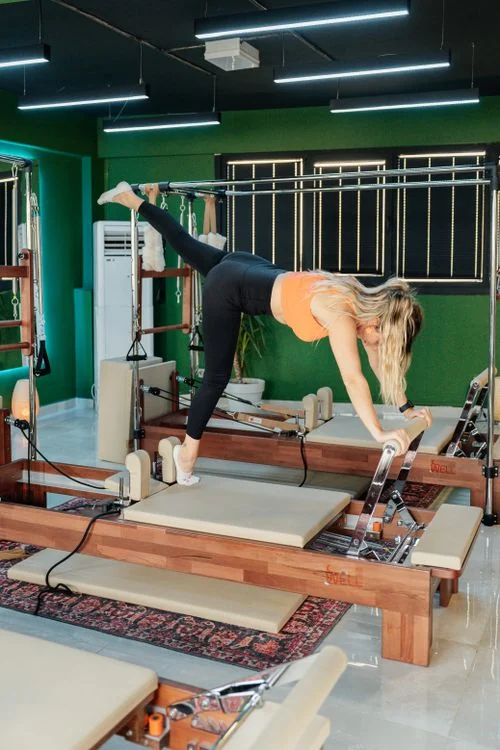
The scene is this: open the course calendar and find words like beginner, flow, dynamic, reformer. You just wanted to move a little bit, now it feels like you have to choose a specialty. Let's order: The Reformer is a tool used in Pilates. It's not an aesthetic treatment, and his presence in a room doesn't say by itself how well the lesson will suit you.
The boom is down. And the numbers have to be read well
In the ClassPass report 2025 the Pilates is the most booked activity for the third consecutive year: +66% compared to 2024, while the Reformer grows by 71%. They are bookings of the platform, not a measure of all practitioners or researches today.
What is the Reformer, explained without words
Imagine a structure with a padded trolley that runs along two guides. Springs, straps, ropes and a support bar allow you to create different exercises. The springs can resist or offer assistance, depending on the movement. You work in various positions: lying, sitting, kneeling or standing, when the level allows it.
A surprising detail: less soft does not always mean easier. In some exercises decrease the support makes it more challenging to control the cart. This is why you do not choose the adjustment by copying the neighbor or video seen the night before. The configuration must take into account the person and the exercise.
Reformer or mat? The useful comparison
In the Pilates with free body, or matwork, you work mainly with body weight and gravity; on the Reformer also comes into play the tool system. It is not a ranking between a serious version and an economic version: both require control and can be challenging. The sensible choice concerns the context in which you learn best.
Would you like something you can practise at home too? The mat can be a starting point. If the Reformer interests you, look for an introductory class and ask how first-time participants are supported. Your questions are welcome.
What to expect from the first lesson
At the beginning you should receive an explanation of the tool: how to go up and down, which parts move, when waiting for directions. A beginner's course should leave room for questions. You don't need to get flexible already or know the name of the exercises; you need to be able to learn without feeling late compared to the room.
You could work on foot supports, arm movements, coordination and torso control. The sequence depends on the school, the teacher and your needs. A good lesson is not measured by the number of spectacular positions you can photograph. It is also recognized by the clarity with which you understand what to do.
First rule CHIARA!: you can say "I don't understand." This is not an embarrassing confession. That's why there's a teacher.
Benefits yes, guaranteed transformations no
The NHS describes Pilates as an activity centered on balance, posture, strength and flexibility. This does not allow to promise a healed back, lost centimeters or a body identical to that of the instructor. If you have pain, an injury or a health condition, you need an assessment of what is appropriate for you: a generic class is not equivalent to a rehabilitation path.
Questions to Ask Before Paying
• What training does the teacher have, particularly on the tool?
• Is there an introductory lesson or an initial evaluation?
• How many people participate and how are beginners followed?
• Can you adapt the exercises to my needs?
• What is the full cost, including any odds, and how do deadlines and cancellations work?
There is no single price valid for all cities and all studies. Compare equivalent services: an individual session and a large class do not offer the same kind of attention. A convenient offer loses charm if the schedules are unworkable or the credits expire before you can use them.
How to dress, without opening a mortgage on the activewear
Ask the study about the rules on non-slip socks and clothing. Choose comfortable garments that do not hinder straps and movements; no purchases are required just because a photo seems to come out of a boutique. The first test is to see if you like training there. The coordinated suit can wait.
Questions That Always Come
Should I get Pilates down first?
Not necessarily: ask for a Reformer route for beginners. The decisive element is the teaching suited to your starting point.
How many lessons do you need to see results?
There is no universal deadline. It agrees concrete goals with the instructor and evaluates the path over time, without relying on a first and then promised online.
Is it suitable for all?
The tool offers possibility of adaptation, but the specific course must be appropriate to the person. Report any needs before booking.
The Reformer can intrigue you just because it sounds fun. That's fine. Then let the real lesson, with a competent person in front of you, convince you to come back.