PASOLINI AND THE JESUS WHO STILL ASKS US QUESTIONS
An unknown young man as Christ, the Sassi of Matera and his own mother as Mary. Inside the Gospel of a filmmaker who did not believe, but took Jesus very seriously.
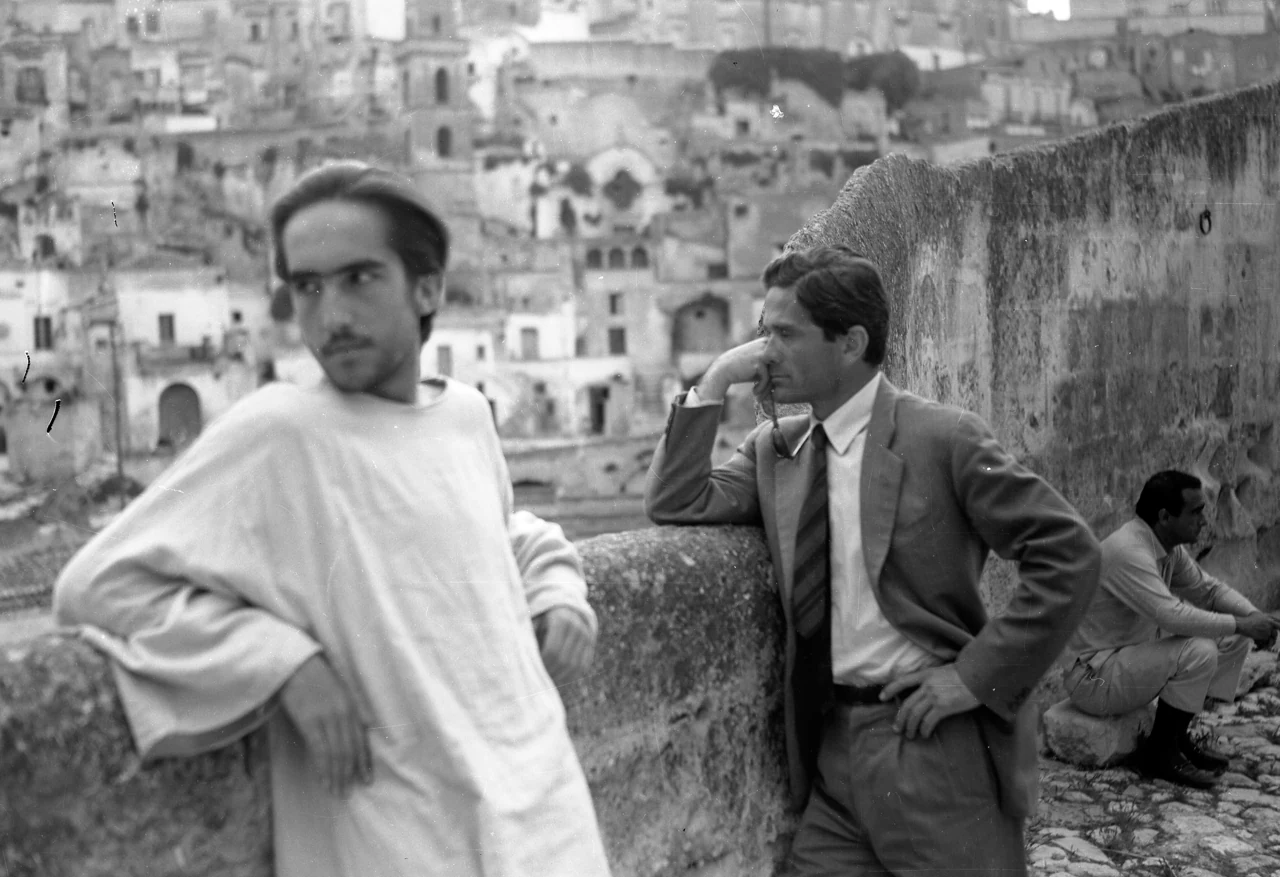
Jesus has thick eyebrows, a gaze that meets the camera’s eye and the face of a young man the audience does not know. Enrico Maria Salerno provides his voice. Behind the camera is Pier Paolo Pasolini. That encounter alone suggests why The Gospel According to Matthew, released in 1964, deserves more than the label “old religious film”.
2 November marks 51 years since the death of the poet and filmmaker, murdered in Ostia in 1975. Returning to this film offers a particular way of remembering him: looking at his work before turning to the lines that have become shareable quotations. And discovering how demanding a portrait of Jesus can come from a man who described himself as a non-believer.
A book in a room in Assisi
The spark came in Assisi in 1962. Pasolini was staying with the Pro Civitate Christiana community; Pope John XXIII’s visit brought traffic in the town to a standstill and kept him in his room. There he found a Gospel and began with Matthew. Reading became a film project, then an urgent desire he shared with producer Alfredo Bini and Father Giovanni Rossi.
It is a story that will make anyone smile who has picked up one of those books left on a bedside table: sometimes we open them to fill a wait; sometimes a page changes our plans for the day. In this case, it also changed cinema history. Reconstructing the film’s beginnings in Cinematografo, Davide Milani recalls the support offered by the Assisi community, including discussions with a biblical scholar.
The finished film bears a dedication to “the dear, happy, familiar memory of John XXIII” — a translation of Pasolini’s affectionate Italian wording. It points to an encounter that was possible without erasing the distance between their positions.
Source: BFI Trailers ↗
Matera, before the postcard
To bring the Palestine of the Gospels to the screen, Pasolini turned to southern Italy. Matera became Jerusalem; local people’s faces entered the frame. Today we recognise the Sassi as a wonder to photograph. Here the stone stands beside bodies, hardship and poverty: it belongs to people’s lives.
The director gives marginalised people a powerful physical presence. Roberto Chiesi, head of the Pasolini Study Centre and Archive at the Cineteca di Bologna, has also discussed this choice. As we watch, we can ask: who fills the screen? Who is heard? Who might remain in the background of another story?
The Gospel speaks of people who are hungry, seeking healing, waiting for a word. Seeing them so close makes our reading less comfortable. Gospel poverty has a face; meeting it requires more attention than appreciating a beautiful photograph.
He chose his own mother to play Mary
The young Jesus is Enrique Irazoqui. Margherita Caruso plays Mary as a young woman; during the Passion, Mary has the face of Susanna Pasolini, the director’s mother. That choice brings a tangible family closeness into the story.
Before that face, we can pause with a mother’s grief for her son without turning every shot into an explanation of the filmmaker’s life. The Gospel story passes through a real person, asked to embody it. For believers, Mary retains her place in faith; on screen, meanwhile, she feels within reach.
Sound also unsettles our habits. The combination of different musical traditions, including Bach, opens the images onto a wider world. The story belongs to a particular place while finding distant resonances. We can sense that meeting of faces and music before finding the language of film criticism to describe it.
A non-believer before the Gospel
Pasolini should not be retrospectively enlisted among converts. Explaining his work, he distinguished his personal position from the poetic and human power he recognised in Christ. The Cineteca di Bologna preserves statements in which the director brings together his Marxist reading and a fascination with the divine that this reading cannot fully explain.
That tension also makes the Catholic response interesting. At the 1964 Venice Film Festival, the film received the Special Jury Prize and the OCIC award, from the Catholic cinema organisation. Recognising the work did not amount to endorsing every position held by its author.
For a reader who believes, there is freedom in this: encountering a work without first asking its maker to resemble us. Faith also allows room for listening. We can recognise a profound question, discuss the answers and return to the Gospel text with fresh attention.
An evening to watch it properly
The film deserves a whole evening, allowing its black and white to become the present. At first, follow the faces; then listen to the weight of Jesus’ words, asking which ones you remembered and which you had softened in your memory.
And stay until the end. The story passes through condemnation and crucifixion, but reaches the Resurrection. Stopping at suffering would change its movement. For Christians, hope opens there; for viewers who do not believe, it remains a passage to engage with.
Afterwards, perhaps, open Matthew. Reread a page you have just seen and notice what the cinema made you feel. Pasolini still asks us questions in this way too: by restoring our desire to read a story we thought we already knew.