We’ve seen those jeans before. Milan, 125 years of style
Flared jeans, a red puffer, a slip dress over a T-shirt. A journey from 1900 to 2025 brings back the clothes in our family photographs and the pieces we would still love to wear.
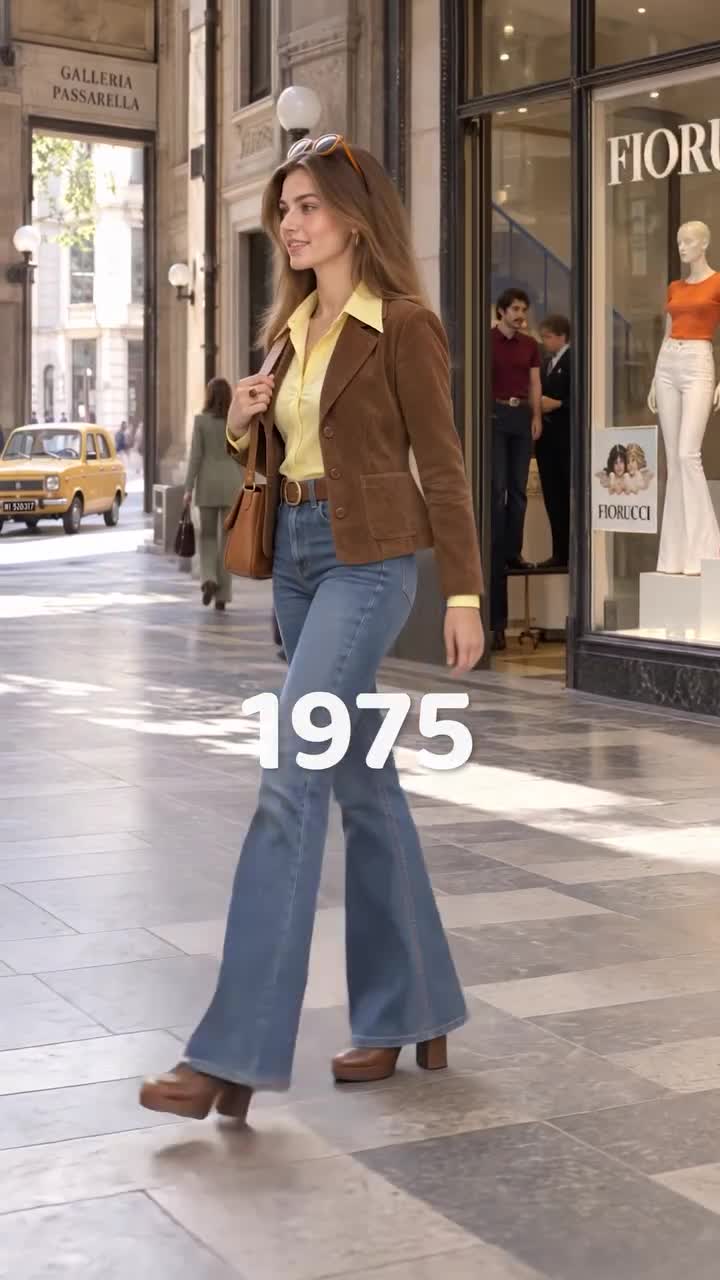
The jeans flare at the hem. The jacket is brown, with a white top underneath. This is the 2025 look in VGraphs’ video. Compare it with 1975, with its yellow shirt and another jacket, and the resemblance is striking. Fifty years apart, yet the shape feels immediately familiar. That detail is where our journey through fashion begins.
In VGraphs’ original video, available on Instagram, Milan provides the setting for a walk through looks spanning 1900 to 2025. Some feel impossibly distant. Others make us want to open a wardrobe, find a photograph or send a message to someone who wore just that coat. Part of the pleasure is recognising a shape before we even read the year.
Before the jeans: a hat and a long skirt
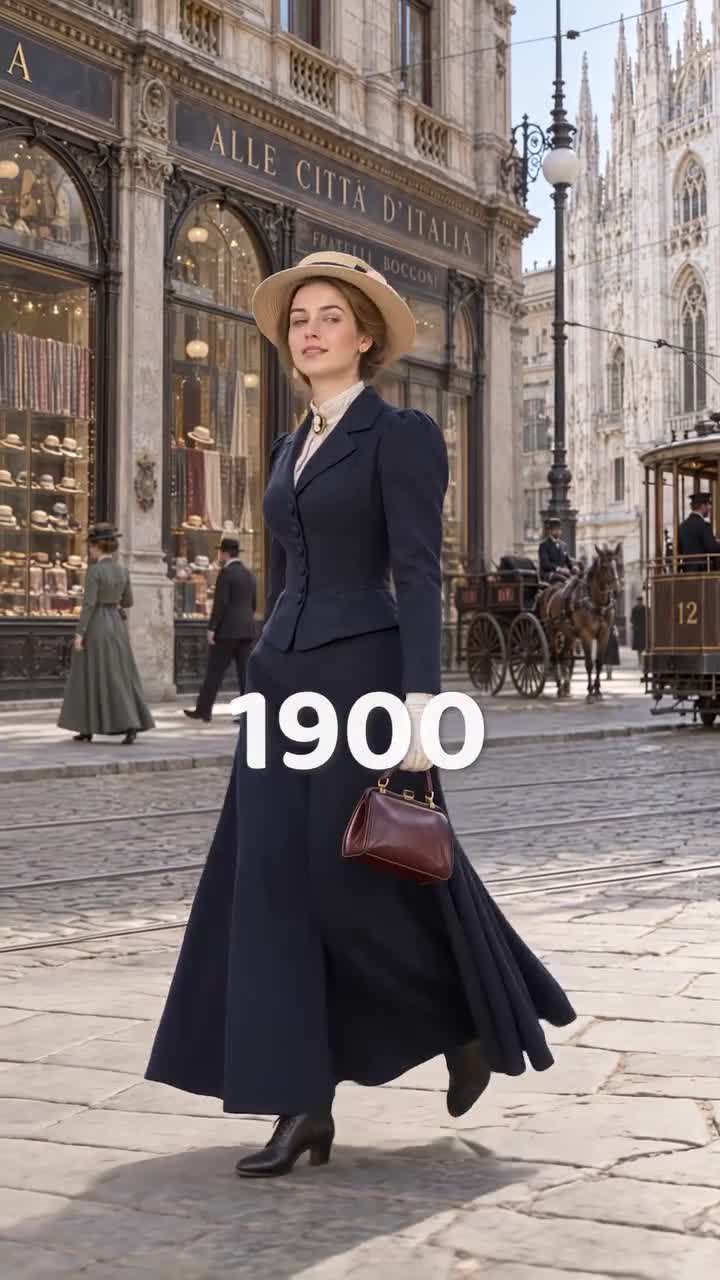
At the beginning of the journey, almost the entire figure is covered: the skirt reaches the ground, the neckline is high and the hands wear gloves. A hat completes the outfit. Our eyes move between the different elements because each appears carefully considered. Within this vision of early twentieth-century elegance, even leaving the house involves a degree of preparation that now feels far removed from our own routines.
In later scenes, hems rise and the outline becomes lighter. Straight dresses and dropped waists are among the most recognisable features of 1920s fashion. The change can be seen in the relationship between fabric and body: the material follows the waist less closely, drawing a different outline around the figure. A real example survives in the 1926 dress held by York Castle Museum.
Of course, one dress cannot stand for an entire city. Age, work and financial circumstances shape what ends up in a wardrobe. The silhouettes we now use to recognise a decade are a selection from a much larger reality. Our family photographs also contain aprons, worn jumpers and clothes repaired to last longer, alongside the outfits brought out for special occasions.
One skirt grows fuller, another grows shorter
In the 1950s, defined waists and generous skirts catch the eye again. In 1947, Christian Dior had presented his New Look in Paris: sloping shoulders, a small waist and abundant fabric around the legs. That silhouette helps us understand images from the following decade too. We recognise it through the movement of the skirt and the way the upper body emerges above its volume.
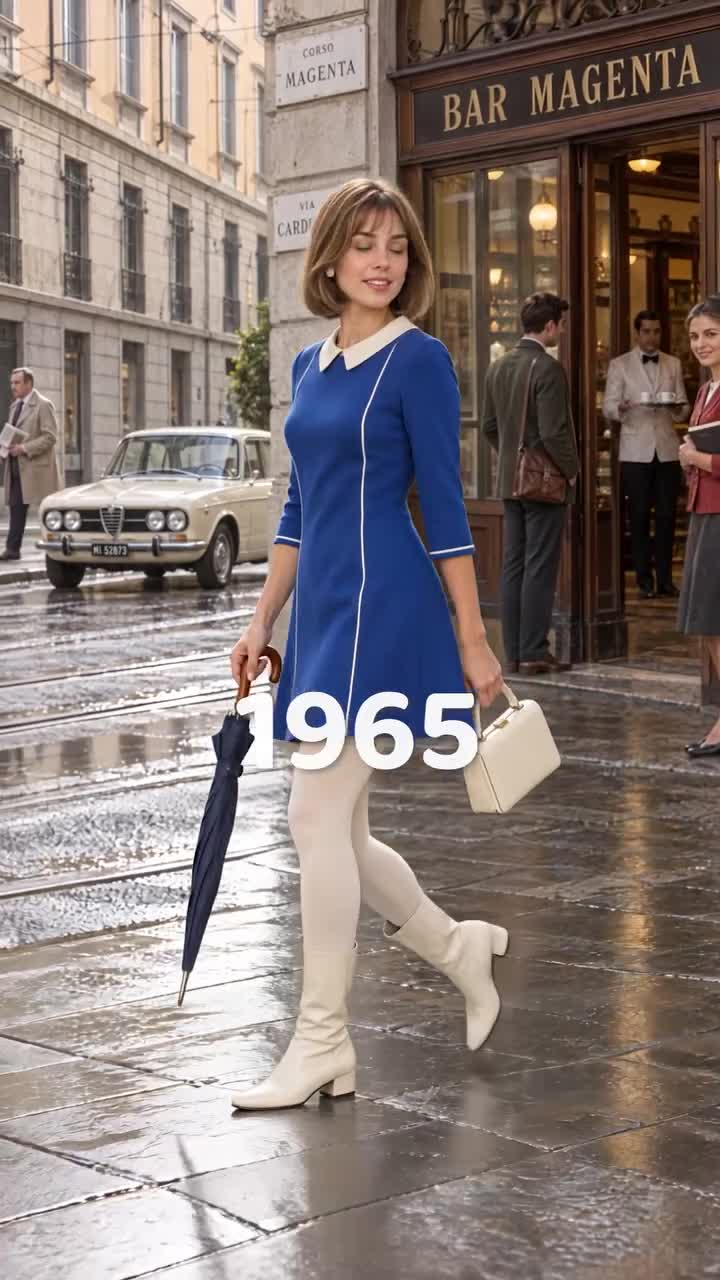
Then come the shorter shapes of the 1960s. In VGraphs’ video, a blue dress and white boots are enough to change the atmosphere. The miniskirt belongs to a period when young women sought wardrobes that set them apart from their mothers. Boutiques, strong colours and Mary Quant’s designs were part of this transformation, explored in the Victoria and Albert Museum’s collections.
Legs become visible in a different way. The balance shifts: less fabric in the skirt, more attention to the boot, the stocking and the colour. Watching these looks appear close together makes the distance between their proportions especially striking. Something as apparently small as the position of a hem can transform the whole figure.
Milan takes fashion in a new direction
During the 1970s, the city takes on a decisive role in Italian ready-to-wear: designer clothes made in series. In 1971, Walter Albini chooses Milan to present the line bearing his name. Around the designers, industry, textiles, shops and communication come together. This is one of the developments that helps explain how Milan becomes an international centre of fashion.
Giorgio Armani’s jacket belongs to that story too, its construction softened and adapted to the female body. A jacket can accompany a working day, go with trousers or change character over a different top. Its significance can also be understood through ordinary gestures: putting your arms through the sleeves, moving, sitting down and keeping it with you until the evening.
And then there are the flared jeans that connect the 1970s with the present. Their popularity in the late 1960s and 1970s connects music with everyday dress; the Levi Strauss archive also records customisation through fabric inserts, embroidery and added panels. A wide hem can hold a very particular memory: a shoe almost hidden underneath, a frayed edge or a shirt someone recognises instantly.
The red puffer and the T-shirt beneath the dress
The red puffer puts colour at the centre of the frame. In 1980s Milan, down jackets also become part of the paninari youth scene, helping a group recognise itself through its clothes. A garment designed to keep out the cold can become a shared desire: something wanted in precisely that shape, with that volume and that label.
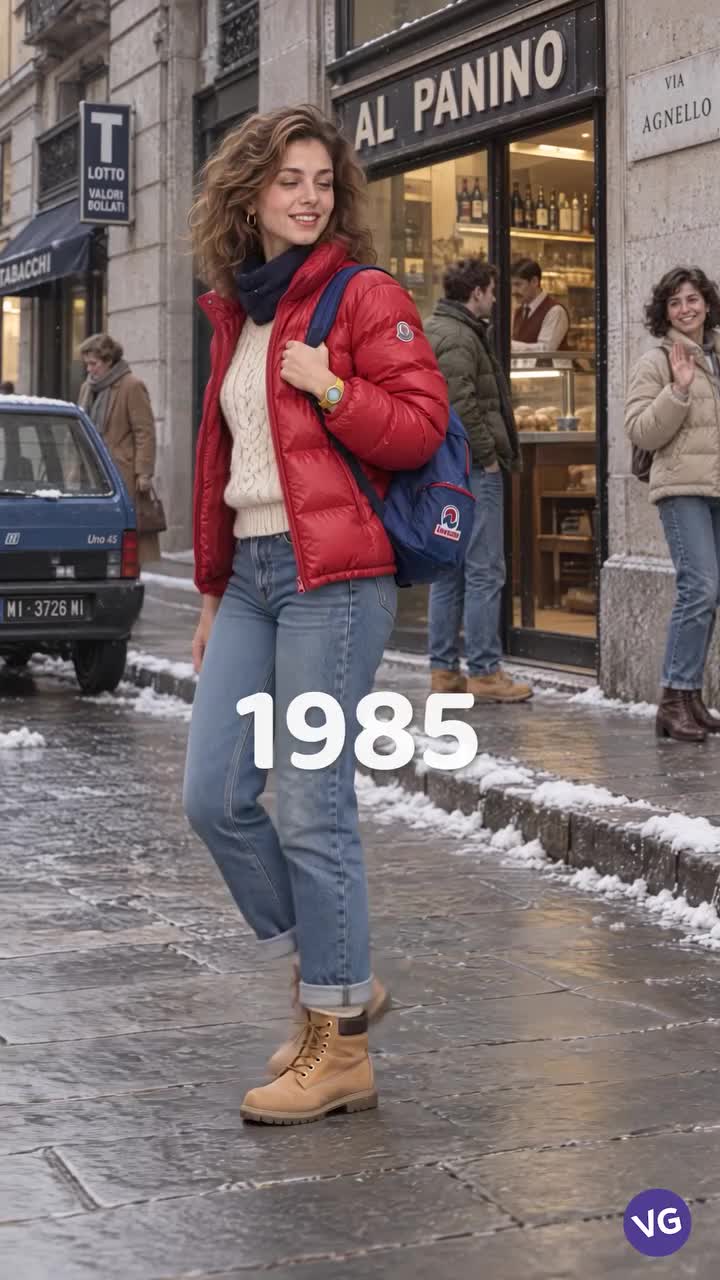
Today, we might look at it through different dressing habits: over a lightweight dress, for instance, as in Cecilie Bahnsen’s collaboration with The North Face, with its flowers and embroidery. The same kind of garment finds a different place beside things we already own. Revisiting these images can give us ideas without sending us straight towards another purchase.
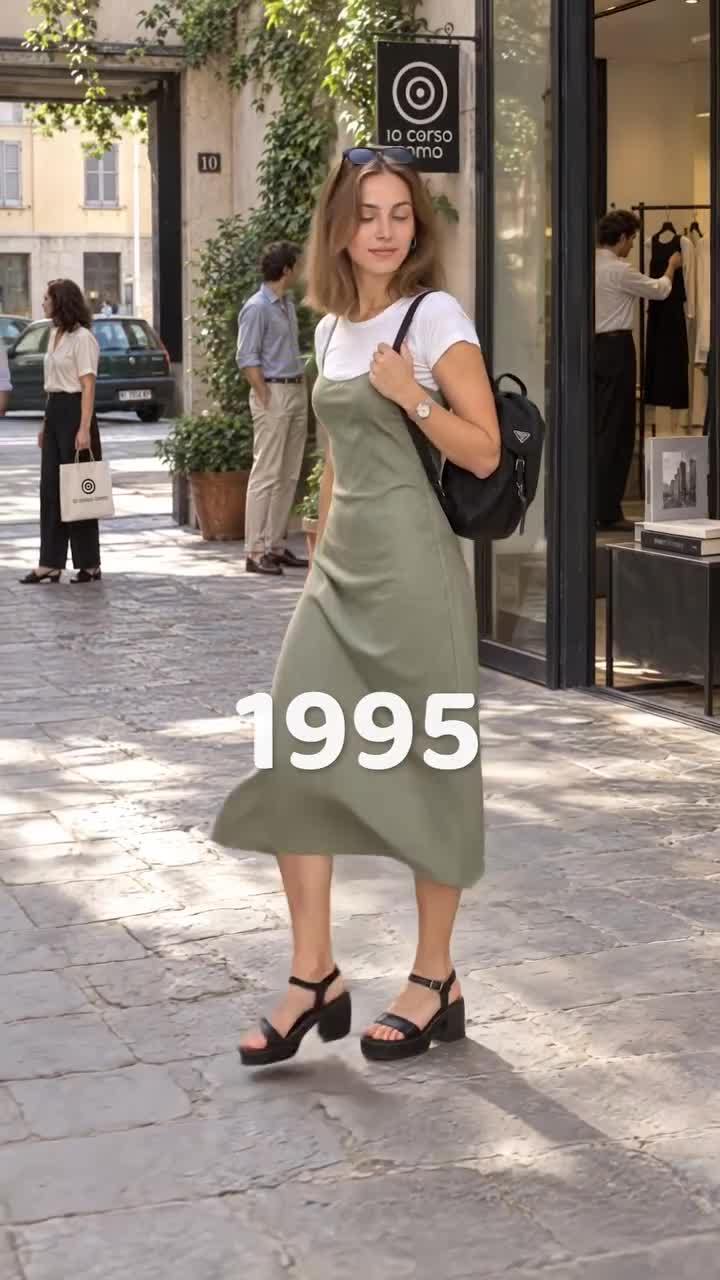
In the 1990s, a slip dress over a T-shirt brings together textures we might usually keep apart. In the video, the dress is green and the T-shirt white, with its short sleeves clearly visible. Then comes the low waist of the 2000s: the jeans sit well below the natural waist, beneath a cropped top. Anyone who wore those trousers may even remember how they felt when sitting down.
The look we keep
The journey ends by returning to wide-legged jeans. Along the way we have seen hats, skirts, boots, jackets and trainers. The resemblances stand out, while the combinations change, along with the moment in our lives from which we look at them. A dress that once seemed merely old in a photograph can reveal beautiful stitching, a print we still enjoy or proportions that feel right for us.
Perhaps one of the looks in the video is something you would wear again. Before searching for a new version, there may be a piece worth trying on: yours, borrowed or kept by someone in the family. It might need a small repair, or simply another way of wearing it. The jeans of 1975 and 2025 resemble each other. Fifty years later, the story we bring to them will be different.
SOURCES AND FURTHER READING
- York Castle Museum — A History of Shaping the Body
- V&A — The golden age of couture
- V&A — An introduction to 1960s fashion
- Camera Nazionale della Moda Italiana — ITALIANA, 1971–2001
- Università Bocconi — Prime sfilate a Milano
- Camera Nazionale della Moda Italiana — Giorgio Armani
- Levi Strauss & Co. — Peace, Love & Bell Bottoms
- Moncler — 70th anniversary
- Fashion Institute of Technology — 1990–1999
- Fashion Institute of Technology — 2000–2009
- VGraphs — @vgraphsinsta · Video originale
Did this story touch your heart?

Psst… you’ll like this too!
Velvet, even on a Monday: how to wear it from work to a party
Read the story ↗Share this story