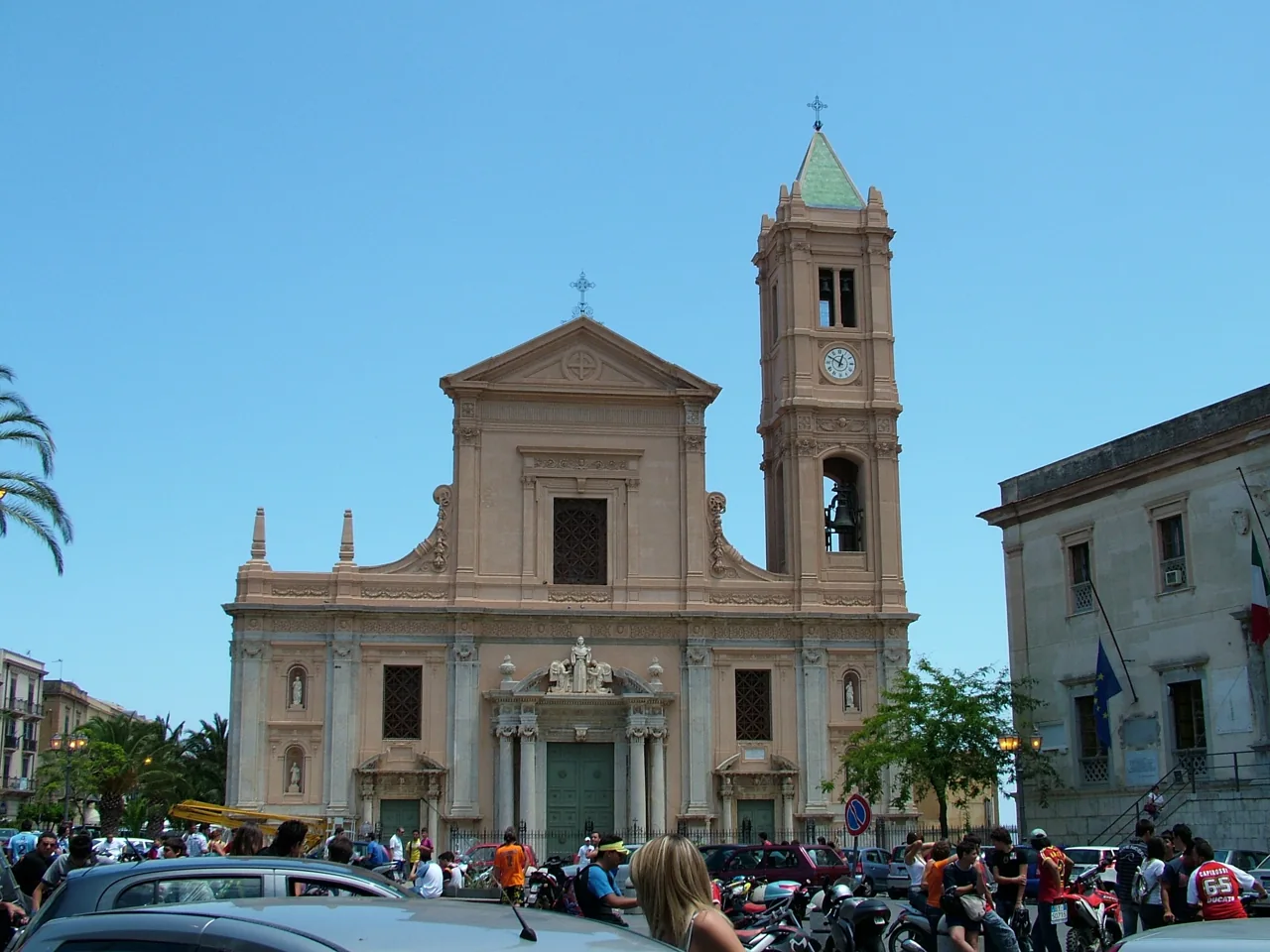
Nazareth’s Basilica of the Annunciation, from the grotto to the mosaics
A grotto, two churches on different levels and images of Mary from around the world. Here is how to read Giovanni Muzio’s design and find the point to which it all leads.

In this story
There is a curious way into the Basilica of the Annunciation in Nazareth: start with the fact that the centre of the building is down below. In the lower church, the rock of a grotto interrupts the regular surfaces of the architecture. Higher up, a great opening keeps that place in sight from the upper church. Around it, images of Mary from different countries change the colour and character of the walls. The photograph and documentary below let you follow this route from home, from the almost bare stone of the grotto to the labour and colour gathered on the floor above.
A grotto inside a twentieth-century building
The present Franciscan basilica was designed by Giovanni Muzio and dates from 1969. It contains traces of earlier buildings and the place honoured in Christian tradition as part of Mary’s home. Two very different scales are at work. A large reinforced concrete building, finished in local stone on the outside, takes shape around a hollow in the rock. See if you can spot in the photograph where the even surfaces of the building give way to the uneven surface it shelters. The word “sanctuary” takes on a visible meaning. Here is a place the architecture keeps open to view.
The first chapter of Luke sets the meeting of Mary and Gabriel in Nazareth. The Gospel gives us the town and their conversation. The memory of the grotto belongs to the tradition of the site. The archaeology records occupation and building at different periods. You can hold all three in view and ask each a different question. What does Luke tell? Where was the Christian memory passed down? What do walls, remains and excavations reveal? That distinction makes the building easier to read. It lets us appreciate what a place means to people without expecting every stone to prove a moment in the narrative.
How to read the lower church
In front of the grotto, a short Latin inscription on the altar gives fresh weight to words you may already know. “Verbum caro hic factum est”: here the Word became flesh. The word added to the verse from John is “hic”, or here. The relationship between this building and its site turns on that single word. The altar makes visible the way pilgrims have kept the memory of the Annunciation, through a particular point to which the eye can return. If you watch the scene on film, notice the contrast between the white altar, the shadows behind it and the walls of the modern basilica around it.
The altar comes from a different phase to the present basilica: it belonged to the eighteenth-century Franciscan shrine. Within a few metres there is a rock face, an altar from an earlier church and the concrete of the modern building. Look at each in turn and you can begin to distinguish what has remained from what was built around it.
Beneath and around the present church lie traces of a Byzantine church, a Crusader church and an earlier Franciscan building. Excavations in the same area have uncovered features of the old village, including cisterns and rock-cut spaces. The place has a story of additions, changes and interruptions. Try imagining a building that changes shape because the people gathering there have different needs over the course of centuries. The place where their attention gathers keeps a recognisable function even as its surroundings alter. The grotto is the feature that lets you move from one period to another without losing the thread of the place.
From shadow into light
Now picture the upper church. Muzio keeps the two spaces together with a large opening framed by a star-shaped design. Look down and you find the grotto again. Look up and both the light and the number of details to notice change. Light from the dome and windows opens up the space, and the marble floor adds its own images and words. The arrangement gives you somewhere to rest your attention. First come the memories held in the stone, then the images that gather centuries of devotion. Even upstairs, among the colours, you can look down and recover your starting point.
The great mosaic in the apse, designed by Salvatore Fiume, pictures the Church professed in the Creed. Among the figures, look for Christ, Mary, saints and popes. Preparing a work on this scale meant enlarging the design and making it in sections in the warehouses of La Scala in Milan. The mosaicist Renato Zoratto took part in the work and returned to see the apse many years later. That story makes you want to look for a close photograph. At a distance you register the whole design. Up close, an outline and the change from one shade to another give you some idea of the many small decisions that go into a single image.
Many images of Mary before you return to the centre
The walls and porticoes gather Marian works associated with different countries and shrines. In the upper church, images linked to Australia, Lebanon, Japan and Canada are among those on the same wall. Notice what this proximity does. In a gallery concerned with the same woman, artists can change materials, clothing, features and outlines. Each brings a visual history that may be familiar to people who grew up thousands of miles from Nazareth. Look at three consecutive panels in a wide photograph. You can begin to see the rhythm with which the surfaces change and the different distances at which it makes sense to look at each one.
Sometimes two images are enough to suggest what it means for a devotion to travel. One work draws your attention to its materials or colours. Another places the emphasis on Mary’s gesture towards the Child. Looking at them together prepares you to see the great apse mosaic and then the small grotto again. The building directs your eye in three ways: towards a detail you can examine, towards a design that fills your view, and towards the plain point where you began. The gallery of images and the archaeological centre share the same church. You can move back and forth between them, mentally as well as physically, and keep both scales in mind.
The south front offers another way to read the building. The words of the Salve Regina run across bands of stone close to a bronze figure of Mary. Lifted from the pages of a book, the Marian prayer stretches across the face of a building. The familiar words, the modern materials and the image that draws the eye back to them are things you have met upstairs too. To finish, watch the documentary move from one floor to the other. Choose a frame of the grotto, a view of the dome and one panel of Mary. Put those together and you have a way to read Nazareth from rock to colour, while keeping hold of the little word “here” from which the story began.
Source: Christian Media Center – Italiano ↗
SOURCES AND FURTHER READING
- Custodia di Terra Santa · Basilica dell’Annunciazione a Nazaret, storia e ambienti
- Custody of the Holy Land · Nazareth, Lower and Upper Basilica
- Custodia de Tierra Santa · Basílica de la Anunciación
- Custodia de Tierra Santa · Plano arqueológico y tradición cristiana
- Custodia de Tierra Santa · El mosaico del ábside y el trabajo de Renato Zoratto
- Christian Media Center · Documentario sulla Basilica dell’Annunciazione
Did this story touch your heart?
Psst… you’ll like this too!
Tiepolo’s Immaculate Conception at the Prado: look to the sky, then find the serpent
Read the story ↗Share this story