Topo Gigio, the woman who created him and the art of bringing him to life
Maria Perego, hidden hands, distinctive voices and stages around the world: the story of the little mouse who still holds grown-ups’ attention.
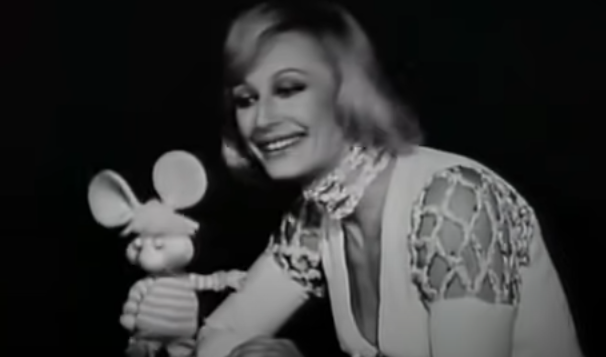
A blond quiff, two large ears and that little voice: Topo Gigio arrives and we want to listen. Even when we already understand his act. A hesitation, a tilt of his head towards the person beside him, a request for affection, and a figure just a few inches tall holds the conversation.
Behind that apparent ease is the work of a woman, Maria Perego, who created both a character and the means to bring him to life. Gigio’s story travels through puppeteers’ hands and actors’ voices, from Italian television to major American entertainment. It reaches all the way to Lucio Corsi: their Sanremo duet has a connection to the mouse’s beginnings worth rediscovering.
Who created Topo Gigio?
Topo Gigio was created in 1959 by Maria Perego and her husband Federico Caldura, a writer and director. His television debut came in Rai’s Alta Fedeltà. Perego would spend years refining his movements and expressiveness.
Creating a puppet means deciding far more than how it looks. How does it listen? When does it lower its eyes? How long should a pause last before it replies? Such choices turn a figure into a character. Its shape gives it a face; rhythm gives it a personality.
Perego’s work belongs to puppetry and performance as much as to the making of an object. Watching Gigio means seeing the result of countless tiny decisions intended to give the audience a sense of someone being there. It is demanding work, especially alongside real people who can improvise and change the timing of a joke.
His voices, from Modugno to Leo Valli
Gigio’s first voice belonged to Domenico Modugno. Peppino Mazzullo would later make that voice familiar to generations. Since 2010, his official voice has been Leo Valli.
The voice is as much a part of his identity as his quiff and ears. Its childlike sound gains meaning through intention and timing: enthusiasm, embarrassment, curiosity and familiarity with the person beside him. Simply producing a high-pitched sound would not convey all of that.
How does he move without visible strings?
In his Ed Sullivan Show sketches, three puppeteers operated the figure while an actor provided the voice. Dressed in black against a black background, the puppeteers disappeared from view. Hands and rods moved the different parts of his body.
Maria Perego controlled the legs and mouth; two other performers moved the arms. Framing and lighting completed the illusion. That tiny body could walk, gesture and turn towards the host with striking naturalness.
The challenge is making everything coincide: movement, speech and reaction. When Gigio seems to listen, his attention is being performed through his body. A gesture too soon or a pause too long would change the scene’s meaning. Understanding the technique makes watching an appearance again even more interesting.
The little Italian mouse who won over Ed Sullivan
Success took Gigio from Italy to Switzerland and Sunday Night at the London Palladium, then to the United States. During the 1960s he became a much-loved presence on The Ed Sullivan Show, a major stage in American television.
His relationship with Sullivan is part of the performance: Gigio draws him into conversations, small mishaps and requests for affection. Joan Rivers was among the writers of his sketches, a revealing detail about the craft that went into those scenes.
The comedy also grows out of their different sizes: an adult presenter, a tiny creature and the time one gives the other. Gigio can interrupt, ask an innocent question or demand attention. His partner makes room for him, and the audience joins in.
Source: The Ed Sullivan Show ↗
From Raffaella Carrà to Lucio Corsi: a musical thread
In Italy, Gigio appeared alongside Cino Tortorella at Zecchino d’Oro and Raffaella Carrà in Canzonissima 1974. Their meeting remains associated with Strapazzami di coccole, a request for affection that became part of his vocabulary.
On 14 February 2025, he sang with Lucio Corsi during Sanremo’s covers night. Their song was Nel blu dipinto di blu. The choice creates a lovely return to his beginnings: Modugno, the song’s performer, had also been the mouse’s first voice.
In May that year, Gigio became the Italian jury’s Eurovision spokesperson. A character born in the early years of Italian television still finds a place within a major international broadcast.
Why grown-ups enjoy him too
Watching Gigio as an adult lets us appreciate two performances at once: the character’s and that of the artists bringing him into being. We can smile at his shyness while admiring the precision of a reply or the way he holds his own in a duet.
There is also pleasure in hearing affection requested so simply. Gigio allows himself to be awkward, to ask questions and to seek reassurance. For viewers, that small freedom can feel restful. His tenderness also leaves room for humour and mischief.
Where to watch him and introduce him to children
Begin with the sketches in The Ed Sullivan Show’s official archive and the Lucio Corsi duet on RaiNews. They offer two different ways to meet the Gigio who talks and sings alongside flesh-and-blood performers.
For young children there is also the animated series, featuring Zoe, Bob and the G-Team. On stage, Topo Gigio – Il Musical centres on the bond between Maria and her creation in a fantasy story directed by Maurizio Colombi, with music by Franco Fasano.
Choose where to begin: a song, a sketch or an animated adventure. Then pause to watch how Gigio listens to the person in front of him. That tiny gesture holds a precious part of Maria Perego’s work: making us feel that someone is answering.
SOURCES AND FURTHER READING
- Topo Gigio — storia e Maria Perego
- Archivio Storico Barilla — Maria Perego racconta
- Radiocorriere TV — Topo Gigio, voci e televisione italiana
- The Ed Sullivan Show — Topo Gigio, animazione e spettacolo
- The Ed Sullivan Show — Origins of Topo Gigio
- RaiNews — Lucio Corsi e Topo Gigio a Sanremo 2025
- Rai Ufficio Stampa — Eurovision Song Contest 2025
- Topo Gigio — serie animata
- Topo Gigio — Il Musical
- The Ed Sullivan Show — Topo the Artist, video ufficiale
Did this story touch your heart?
Share this story