In Porta Venezia, Art Nouveau starts with two houses on one street
Painted ceramics wrap around a corner on Via Malpighi. A little farther along, the same architect lets ironwork shape the view. All four façades on this walk are free to see.
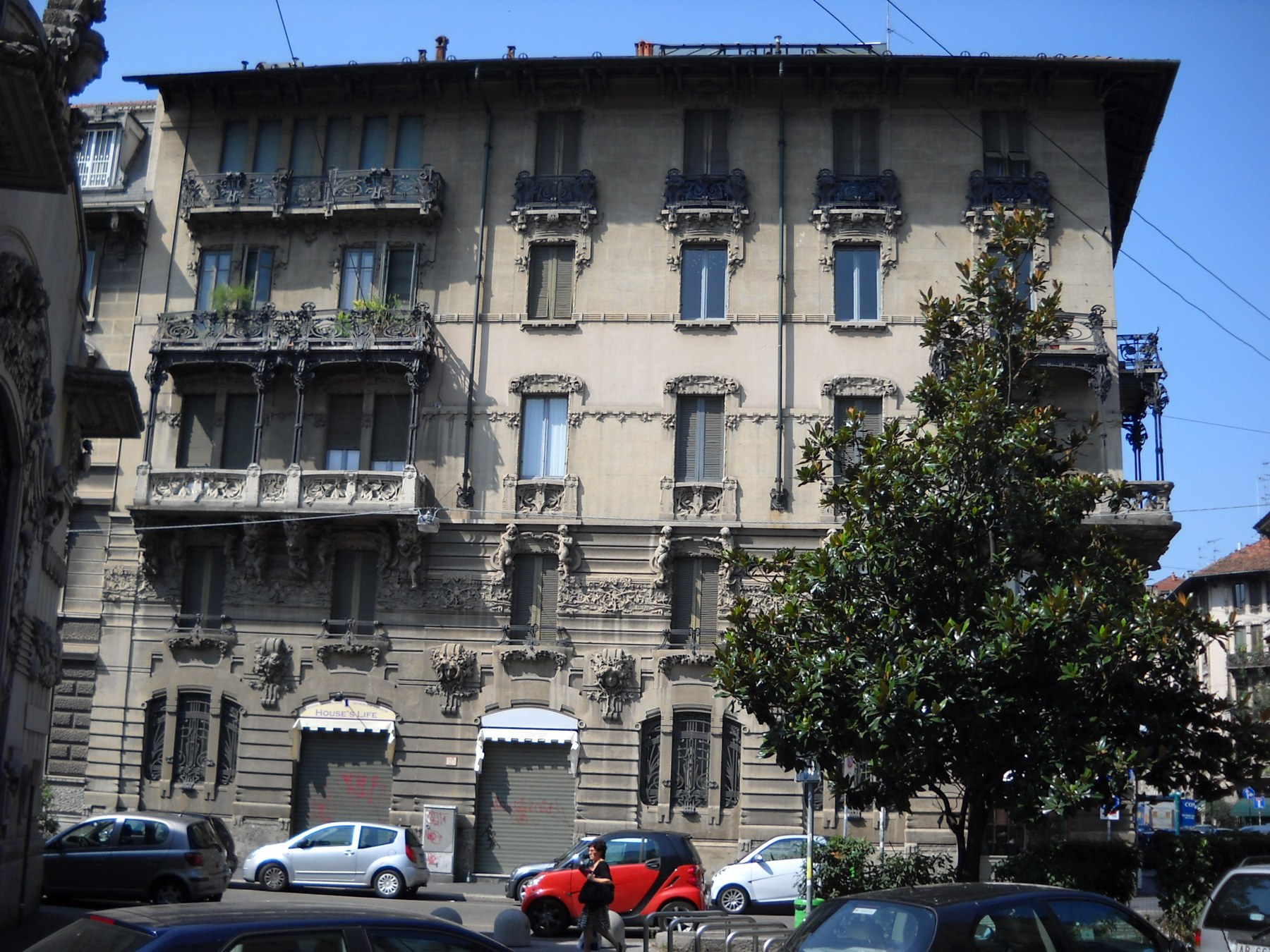
It takes only a few minutes to walk down Via Malpighi. At number 3, by Via Sirtori, the ceramic figures go on around the corner. At number 12, towards Via Melzo, the shadows of the ironwork move across the façade. Giovanni Battista Bossi designed both houses. Half an hour from Porta Venezia M1 gives you time to see how he approached the same street twice. With an hour, you can follow the decorators’ work as far as Corso Venezia and Via Cappuccini. The façades are free to see from the street, and easiest to make out in daylight. The metro fare is separate and the interiors require a special opening.
A painted wall, a shadow in iron
At the Via Sirtori corner, Casa Galimberti catches your eye before you can take it all in. A painted figure beside a window leads to a plant motif and then to the next balcony. Where the two streets meet, the ceramics turn the corner too. Close up you see individual figures. A little farther back, you can see why Bossi gave entire bands of the façade over to colour.
Giovanni Battista Bossi designed Casa Galimberti for the Galimberti brothers at the beginning of the twentieth century. Seen from outside, the extent of the ceramic work becomes clear. The colours mark out the openings and keep going as the façade turns the corner. If you take a close photograph of a pair of figures, take a wider one as well. You’ll be able to put the detail back where it belongs when you look at the pictures later and see how the building stretches down both streets.
At 12 Via Malpighi, on the corner of Via Melzo, you reach Casa Guazzoni. Here too Giovanni Battista Bossi had a narrow street, a corner and people passing beneath the balconies. In this building the movement comes out of the wall, into Alessandro Mazzucotelli’s wrought iron. Its lines look different depending on where you stand.
Via Melzo gives you room to follow the lines of a railing. The ceramics on the other house live against the wall, while the iron here reaches out into the street. As the light moves, the curves cast a different shadow. Two balconies at roughly the same height show how differently Bossi worked a few doors apart.
Before you leave Via Malpighi, spend a moment at street level. A door or a window passes in front of you even when you’re in a hurry. Follow the façade from there to the first balcony. It helps you see what these two houses do with the narrow space between a building and someone walking past.
What photographs keep in place
At Corso Venezia 47, the rough base of Palazzo Castiglioni comes before its doorway. It looks like a piece of rock left between the buildings. Higher up, Giuseppe Sommaruga made room for two large female figures, removed shortly after Ermenegildo Castiglioni’s residence opened. In the historic photograph of the doorway, the figures stand either side of the entrance. Look at it by the door and, for a moment, you get a sense of how large they were next to the people now walking down the avenue.
The photographer, F. Borgia, framed the entrance in 1903, just after the scaffolding came down. Ernesto Bazzaro’s figures stood for Peace and Industry. They also made it into the satirical cartoons of Guerin meschino. Castiglioni had them taken away and Sommaruga reused them at Villa Faccanoni, at Via Buonarroti 48. In Porta Venezia the photograph remains, showing a building that gave the city something to argue about as soon as it came into view.
Make your way to 8 Via Cappuccini, where Palazzo Berri Meregalli was built to a design by Giulio Ulisse Arata between 1911 and 1913. Start with the corner. The mass of the building, the decoration and the changes in surface are easier to take in with a little distance. From one side of the road you can see the outline. Close up you’re in a better place to pick out the details set into the walls. It’s a good final stop because the building puts the term Milanese Art Nouveau back into question. Here the style sits alongside references to older buildings and a more imposing overall shape.
At Palazzo Berri Meregalli you come across Mazzucotelli again, working with Arata on the iron. Around it is the work of mosaic artists and sculptors. A name from Via Malpighi takes on a shape you’ve learnt to recognise. From here, head back to Corso Venezia for Palestro on the M1. You finish on a different street from the one where you first saw his balconies.
From Via Cappuccini, Corso Venezia takes you back to Palestro M1. With more time, the YesMilano walk around Porta Venezia has other addresses. If you go back by Via Melzo instead, look once more at the ironwork on the balconies. After the last palazzo, you can recognise the same maker in those curves. It is something the two houses on Via Malpighi tell you best once you have seen how they belong to the rest of the neighbourhood.
SOURCES AND FURTHER READING
Did this story touch your heart?
Psst… you’ll like this too!
In Ortica, Jannacci’s Milan and Ambrosoli’s share a street
Read the story ↗Share this story