Harry Potter behind the magic: real secrets of props, costumes and effects
A door that really moves, feathers attached one by one and a miniature castle: the work behind the films is an adventure of its own.
Jump to what you need
- The useful question is: how did they do that?
- The Great Hall had a real stone floor
- The Chamber of Secrets door is mechanical
- Hogwarts was also a model
- A feather and a fishing rod
- The Invisibility Cloak had different versions
- Buckbeak needed patience
- Potion jars were already telling a story
- Hermione's dress also represents working time
- Graphic design supplied everyday life
- Keep exploring Hogwarts!
The useful question is: how did they do that?
One of the pleasures of Harry Potter is discovering that understanding a trick need not remove the enchantment. It can make the result more impressive. An object visible for a few seconds may represent drawings, experiments, materials and people solving a very practical problem. Making a feather fly is a different task from imagining a flying feather.
This walk behind the scenes concerns the original films. Their techniques and objects should not automatically be attributed to the new series. Think of it as an invitation to watch with an extra question: which craft made this image possible? Emotion and curiosity need not compete. We can enjoy both, even in the same scene, without turning a comfortable evening into a technical examination.
The Great Hall had a real stone floor
The Great Hall was built in 2000 for the first film with York stone flooring. The imaginary school therefore had a physical surface, weight and texture beneath its adventures.
Next time, notice how rooms suggest temperature and sound. A floor can make you imagine echoing footsteps; a huge room can make you feel small. We assemble those impressions almost without noticing. Cinema works partly through our memory of materials. Nobody has to say stone for a building to feel solid and old. A seemingly modest construction choice can help an audience believe in an entire institution and the lives taking place inside it.
The Chamber of Secrets door is mechanical
The snakes on the Chamber of Secrets door are not simply a digital image. The door built for filming uses articulated elements, moving along tracks and powered by a hidden motor. A technical choreography sits behind the fictional danger.
That detail gives us another way to watch a scene. Instead of asking only whether an effect looks realistic, try imagining what was physically in front of the camera. Then explore the effects department's demonstration. The pleasure is not in guessing correctly. It is in discovering how many routes can produce the same sensation of wonder, and how carefully a mechanism must be arranged to seem effortless on screen.
Hogwarts was also a model
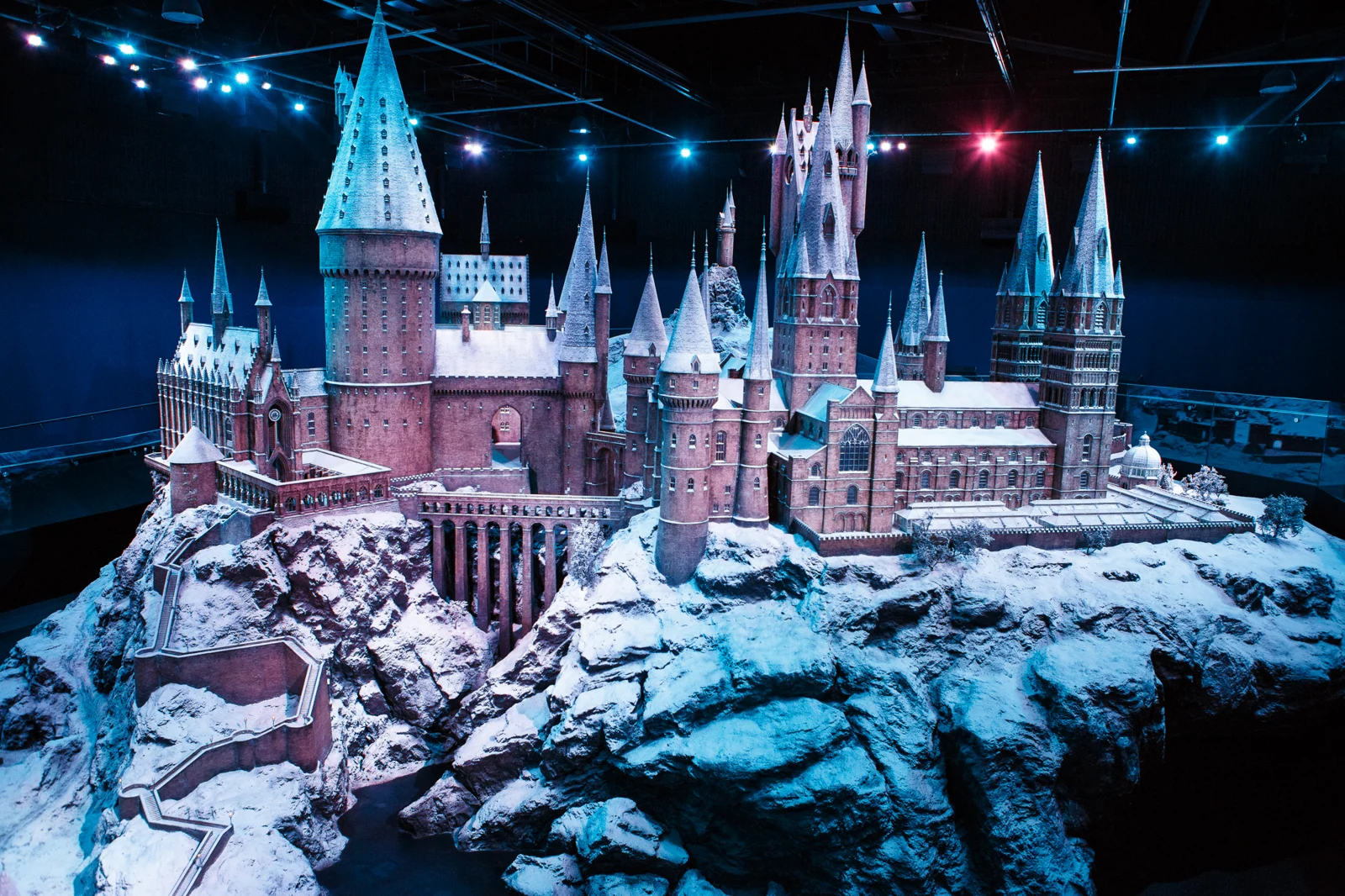
The miniature castle, created for the first film, was photographed and combined with digital effects. The school's screen presence therefore joins physical construction and visual work.
It is a useful response to the temptation to divide cinema into two boxes: entirely real or entirely computer-generated. One image may involve several techniques. When you look at an imagined building, ask how its scale affects your feelings. Does it seem welcoming, overwhelming or far away? A model is not merely a substitute for a large building. It is a tool for composing a view and deciding how an audience will encounter it.
A feather and a fishing rod
John Richardson has described using a fishing rod and feather for Wingardium Leviosa. A straightforward idea can sit at the centre of a memorable image.
This is an encouraging detail for anyone who assumes creativity requires extraordinary equipment. A useful first step is to define the problem. What must the object do? Where will the audience see it from? What must stay outside the frame? Those are questions you can also try while making a little video at home. The most interesting solution is not always the most complicated, and a clear viewpoint can matter as much as an elaborate device.
The Invisibility Cloak had different versions
Several versions of the cloak were made, including one with a green lining for visual effects work. The visible costume also has its own patterned and decorated appearance.
A screen object need not accomplish every task on its own. The best version for a close-up may not suit an effects shot. Think about the work needed to let an audience recognise one object while production uses different solutions. What we experience as continuity is also a collaboration. Different departments must speak a shared visual language, keeping details sufficiently consistent for us to follow the story without stopping to consider how the pieces fit together.
Buckbeak needed patience
The Creature Effects team individually inserted and glued feathers into the Buckbeak models. An impossible animal also depends on patient, repeated work.
Look at the result while considering the distance between an idea and a surface. Saying hippogriff takes a second. Deciding what it should look like when light touches it is another activity. This detail helps reveal a value that often stays hidden: repetition can be part of creativity. Performing a precise action well, many times, can contribute as much to a surprising image as inventing something new. The finished creature brings those kinds of imagination together.
Potion jars were already telling a story
The Potions classroom contained more than 950 jars, with labels designed by MinaLima. A room's contents kept describing the world behind the people standing at its centre.
Try looking at the edges of a frame. You need not hunt for a secret message in every object; simply notice what makes a place recognisable. If we removed its occupants, could we still guess who lived or worked there? A convincing room can suggest habits and personality without dialogue. It is an idea worth carrying into our own photographs too: the background always has something to contribute, even when nobody calls attention to it.
Hermione's dress also represents working time
Jany Temime's pink Yule Ball dress took three months to make. That invites us to see a costume as something designed for movement, rather than simply an attractive still photograph.
During a party scene, ask which clothes draw attention, which follow a person's movement and which tell us someone feels awkward. Costume can communicate confidence, discomfort or a desire for change before a character speaks. You do not need tailoring knowledge to notice that. Watch the relationship between a body and what it wears. A memorable entrance is made from movement, colour, performance and the response of the people nearby.
Graphic design supplied everyday life
MinaLima designed sweet packaging, books and newspapers among many other pieces of the magical world. That work helps an invention become somewhere people appear able to shop, study and read the news.
A simple exercise can reveal how much framing matters. Choose an object at home, photograph it closely, then photograph it with its surroundings. Without changing the object, you have already changed the questions it raises. Does it seem precious, amusing, disturbing or out of place? Back in the film, notice when an object is concealed, revealed or left in the background. Curiosity about technique becomes something you can explore without building a replica. The aim is not to reproduce a scene perfectly. It is to recognise that a view involves decisions about what to include, what to leave outside and how much time the eye receives to investigate a detail.
For your next marathon, choose a different craft for each film: costume, objects or rooms. There is no need to interrupt the story every few minutes. Keep one small curiosity in mind, then name the detail that surprised you afterwards. Discovering the hands behind the magic does not take us away from Hogwarts. It brings us closer to the people who made it visible, and adds another reason to watch an old favourite carefully again.
Keep exploring Hogwarts!
SOURCES AND FURTHER READING
- Warner Bros. Studio Tour — Great Hall
- Warner Bros. Studio Tour — SFX and VFX
- Warner Bros. Studio Tour — Art Department
- Harry Potter — Filmmakers video series
- Warner Bros. Studio Tour — Creature Effects
- Warner Bros. Studio Tour — Props
- Warner Bros. Studio Tour — Costumes
- Harry Potter — MinaLima design retrospective
Did this story touch your heart?
Psst… you’ll like this too!
Harry Potter books and films: the differences that change how you see the story
Read the story ↗Share this story