Marrakech: Majorelle blue and the voices of the medina
A painter, a garden saved and a square alive with encounters. Follow colour, people and the paths of water through Marrakech.
Majorelle blue stays with you. Set against the green of the plants in Marrakech, it shows how a colour can alter an entire place: walls look sharper, shadows deeper, every pot appears to have its own position in the garden's composition. The temptation is to photograph everything. Looking for a little longer reveals the work that holds this beauty together.
The Jardin Majorelle began as the project of the painter Jacques Majorelle. Yves Saint Laurent and Pierre Bergé bought it in 1980, saving it from redevelopment as a hotel complex. The story offers a way into Marrakech itself: creativity grows through encounters and through people who recognise the value of a place and choose to look after it.
Book the garden, leave room around it
Start with the official ticket office: admission is purchased online for a chosen date and time. That reservation can be the fixed point of a morning, with the hours afterwards left open. Arriving with another appointment close behind makes it all too easy to walk through the garden watching the clock.
Anyone interested in fashion may also want to visit the nearby Yves Saint Laurent museum, taking account of the galleries actually open. The permanent exhibition gallery will close from 29 November to 18 December 2026 while a new display is installed, with reopening announced for 19 December. During that period, choose tickets around the spaces you can visit rather than buying a combined ticket assuming every gallery will be accessible.
Majorelle brings plants, architecture and colour into one composition. How you enjoy it will depend on what draws your eye: the shapes of leaves, the relationship between walls and foliage, or an artist's ambition to imagine an entire environment. On a shared visit, there is pleasure in pointing out something your companion was about to walk past.
A square sustained by voices
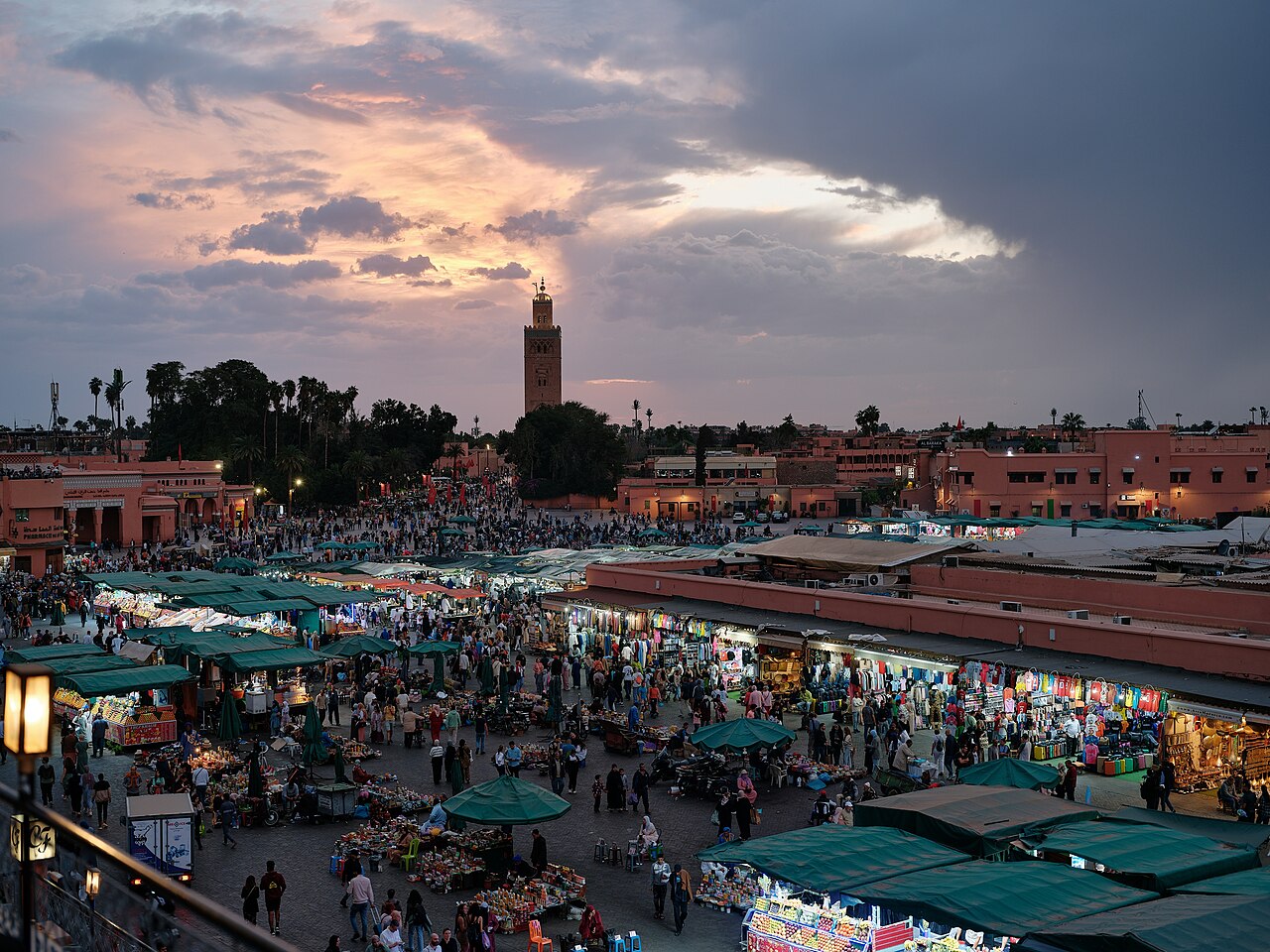
Then there is Jemaa el-Fnaa. Much of its importance lies with the people: storytellers, musicians and audiences gathering, listening and moving on. The square's cultural space is recognised as intangible cultural heritage. Here that description becomes something tangible, because an oral tradition lives on when someone makes time to hear it.
Return at different times to notice how light and activity change. At ground level you are part of the movement; from a terrace you can see how it fills the space. These are different experiences of the same square. Choose a café, read its menu and know what you will spend before sitting down: the view comes with a purchase whose price deserves a look first.
Ask before photographing someone working or performing. It is a straightforward courtesy and a chance to establish whether payment is expected. An encounter feels more human when a question comes before the camera.
Following water through the medina
In Mouassine, Le Jardin Secret offers another way to understand the city. Two distinct gardens, one exotic and one Islamic, turn attention towards interior spaces, pavilions and crafted surfaces. Zellij, tiles assembled into geometric patterns, reward a closer look: what seems a continuous design from several steps away resolves into separate fitted pieces.
Follow the water through the site. Traces of pipes, reservoirs and channels show how it was distributed around the complex. The historic khettara network intercepted groundwater and brought it into the city. A fountain feels different once you understand its supply: behind the sound lay engineering skill and the careful management of a precious resource.
That idea of rooms gathered around an inner space can also help when choosing a riad to stay in, provided you check the actual accommodation. Courtyard photographs tell only part of the story. Ask which room you are booking, how many stairs there are, how luggage reaches the building and how close your transfer vehicle can get. A few answers before booking can make arrival much easier.
Make useful decisions before leaving
Three full days give you time for the medina, the gardens and an unplanned stop that catches your interest. For a short break we suggest staying in Marrakech rather than adding an excursion outside the city to every day. It is easier to return to a shop when there is time to understand an object, ask a question and listen to the answer.
For maps, messages and bookings, decide how to get connected before you travel. One option is a Simbye Morocco eSIM, after checking your exact phone model and that the device is unlocked. The data plan described does not include a Moroccan number, conventional mobile calls or SMS. Code CHIARAMAG15 gives 15% off eSIMs; phone numbers and wallet top-ups are excluded. Check the data allowance, validity and discounted total before paying.
If Marrakech is one stop on a longer journey, our article on travelling across several countries looks at the connection choices to make. Then maps can return to their simplest job: helping you find somewhere you want to stay a little longer.
SOURCES AND FURTHER READING
This article contains an affiliate link and code: CHIARA! may receive a commission on purchases made through the link or using the code.
Did this story touch your heart?
Psst… you’ll like this too!
Things to do in Viterbo and beyond on Wednesday 2 December 2026
Read the story ↗Share this story